VOC Remediation Services
What Are VOCs and Why Are They a Problem?
Volatile organic compounds (VOCs) are a broad group of carbon-based chemicals that readily evaporate under ambient conditions. Common VOCs include petroleum-related compounds such as benzene, toluene, ethylbenzene, and xylenes (BTEX), as well as solvents, fuels, and other industrial chemicals.
VOCs are commonly encountered at industrial, manufacturing, fuel-storage, transportation, and waste-management sites. Depending on site specific conditions and their properties, VOCs may be present as dissolved groundwater contamination, soil gas, light non-aqueous phase liquid (LNAPL), dense non-aqueous phase liquid (DNAPL), or sorbed mass in low-permeability soils. These contaminants can migrate through soil, groundwater, and vapor pathways, creating long-term risks to groundwater resources and potential vapor-intrusion concerns.
Common Sites with VOC Contamination
- Fuel terminals, refineries, pipelines, and UST facilities
• Industrial manufacturing and processing facilities
• Solvent handling and chemical blending operations
• Aerospace, metalworking, and maintenance facilities
• Industrial landfills and disposal areas
• Former dry-cleaning and degreasing operations
Thermal Remediation: A Reliable Solution for VOC Source Zones
In situ thermal remediation applies heat directly to contaminated soil, groundwater, and rock to accelerate the physical, chemical, and biological processes that remove or degrade VOCs. Unlike conventional extraction technologies alone, thermal treatment can rapidly address concentrated source zones, residual NAPL, and contaminant mass stored in low-permeability soils or fractured bedrock.
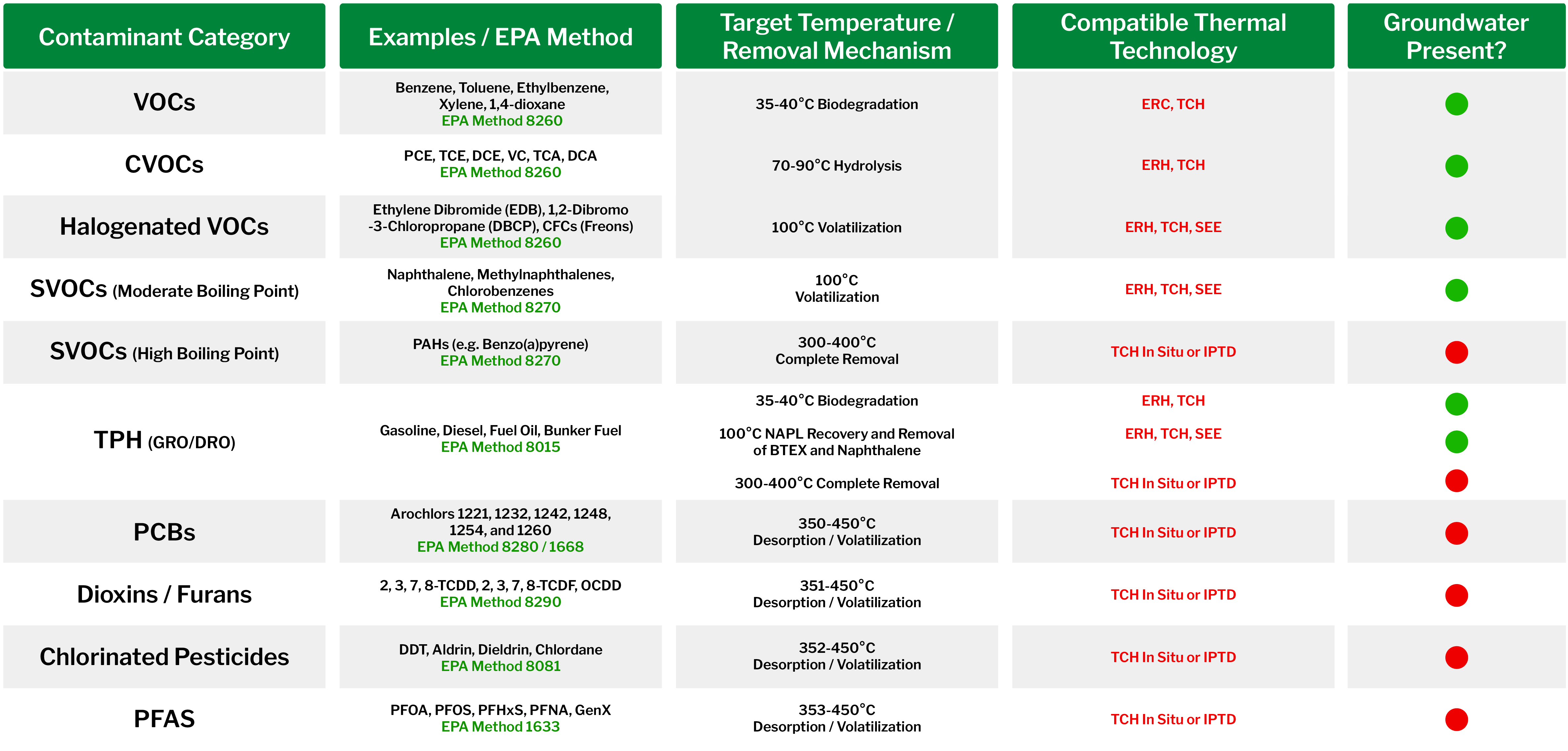
100°C Treatment: Volatilization and Co-Boiling
|
Typical target temperature |
Primary mechanism |
Heating to the boiling point of water dramatically increases VOC vapor pressure and mass-transfer rates. Steam generated in the subsurface strips VOCs from soil and groundwater and transports them toward extraction wells. When NAPL is present, co-boiling rapidly transfers contaminants from an immobile liquid phase into a recoverable vapor phase. Recovered vapors, water, and any mobile NAPL are collected and treated aboveground.
Thermal treatment is typically focused on the source area where contaminant concentrations and mass are highest. Lower-concentration dissolved plumes outside the heated area may be better addressed through a treatment train that combines thermal source-zone treatment with technologies such as injection technologies, bioremediation, monitored natural attenuation, groundwater extraction, or another polishing remedy.
Required energy input and operating duration are site-specific. Key factors include cleanup goals, initial contaminant mass, soil moisture and organic carbon, VOC properties, co-contaminants, groundwater flow, treatment depth, and heat losses. TerraTherm uses these inputs to select the optimal heating technology or technologies and establish the design temperature, energy density, extraction capacity, and endpoint strategy.
Moderate-Temperature Treatment: Thermally Enhanced Hydrolysis
|
Typical target temperature |
Primary mechanism |
Certain VOCs, including compounds such as 1,2-DCA, ethylene dibromide (EDB), carbon tetrachloride (CT), and dichloromethane (DCM), can degrade substantially faster through hydrolysis at elevated temperatures. Where contaminant-specific kinetics support this approach, heating below the boiling point of water may allow significant in situ destruction without the infrastructure associated with boiling-based systems.
After the treatment zone reaches its design temperature, substantially less power is generally required to maintain it than to complete the initial heat-up. Below-grade heater completions and a smaller aboveground footprint may also help preserve access in operating facilities, buildings, and transportation corridors. Vapor control, monitoring, and extraction requirements remain site-specific and are established through design and risk evaluation.
Low-Temperature Treatment: Thermally Enhanced Bioremediation
|
Typical target temperature |
Primary mechanism |
Gentle heating can increase microbial activity, improve amendment distribution, and increase contaminant availability for biodegradation. This approach may accelerate cleanup while requiring significantly less energy and infrastructure than higher-temperature remedies.
TerraTherm can use low-profile, low-power heaters to warm the target interval uniformly while bioremediation amendments are delivered through nearby or shared installation locations. This integrated approach may shorten the treatment period and reduce contaminant mass flux from the source area.
The optimum temperature depends on the microbial community, amendment system, geochemistry, and target compounds. Temperature limits and performance criteria should therefore be established through site-specific biological testing and monitoring. Because the target temperature is well below boiling, the approach has significantly lower energy and infrastructure requirements than 100°C-temperature treatment; however, vapor control and other safeguards are still evaluated for each site.
Our Heating Solutions for VOCs
Electrical Resistance Heating (ERH)
ERH passes alternating electrical current through moist soil and groundwater between subsurface electrodes. Electrical resistance of the soil and water to the current flow converts energy to heat within the treatment zone, allowing ERH to heat many heterogeneous formations with sufficient moisture to near the boiling point of water. ERH can also be operated at lower temperatures for thermally enhanced hydrolysis or bioremediation.
ERH performance depends on adequate moisture and electrical conductivity. Dry or highly resistive formations may limit power delivery, and although water addition at electrodes can mitigate electrode dry-out, it is not effective in every geology. A robust design therefore evaluates the range and spatial distribution of electrical resistivity, moisture conditions, groundwater flow, electrode layout, and the ability to maintain balanced power input.
For 100°C-based treatment, vapor extraction is used to maintain pneumatic control and recover volatilized contaminants. Depending on groundwater flow and the potential for mobile NAPL, multiphase extraction may also be used for hydraulic control and liquid recovery.
Thermal Conduction Heating (TCH)
TCH transfers heat from subsurface heaters into the surrounding soil or rock by thermal conduction. Because it does not rely on soil moisture or electrical current flowing through the formation, TCH can be applied in wet or dry soil, above or below the water table, and in fractured rock. The relatively narrow range of thermal conductivity encountered in most geologic materials supports uniform and predictable heating.
TCH can cover the full temperature range used for CVOC treatment, from low-temperature bioremediation enhancement to moderate-temperature hydrolysis and 100°C boiling and volatilization. In fine-grained soil, localized drying near heaters can increase vertical vapor permeability and help create pathways for recovered vapor to move up into the vadose zone and toward extraction wells.
For 100°C-based treatment, the system includes vapor extraction to maintain pneumatic control and capture contaminants. Multiphase extraction may be added where groundwater inflow or mobile NAPL requires hydraulic control and liquid recovery.
Steam Enhanced Extraction (SEE)
SEE injects steam into permeable saturated formations to deliver heat rapidly, mobilize NAPL, and strip or volatilize CVOCs. It is generally best suited to sand, gravel, permeable fill, or fractured rock with sufficient connected permeability to distribute steam. Where site conditions are favorable, wider well spacing and high energy-delivery rates can make SEE a cost-effective option for CVOC source zones.
Because steam is injected under pressure at temperatures above 100°C at the injection point, SEE is not typically used for controlled low-temperature hydrolysis or bioremediation enhancement. Condensed steam also adds water to the treatment zone, so a carefully designed extraction network is needed to recover vapor, groundwater, and NAPL and to maintain pneumatic and hydraulic control.
SEE can be combined with ERH or TCH at heterogeneous sites. Steam can efficiently heat higher-permeability intervals, while ERH or TCH addresses lower-permeability zones that steam may not contact effectively.
In-Pile Thermal Desorption (IPTD®)
IPTD treats excavated VOC-contaminated soils using TCH in engineered aboveground treatment piles. The approach provides controlled heating, uniform treatment, and complete vapor capture, making it particularly attractive for redevelopment-driven projects, excavation support, and accelerated cleanup schedules.
Will Thermal Work for Your Site?
Tell us about your site and we'll tell you whether thermal treatment applies and which approach fits. If it isn't the right remedy, we'll say so.
How Does Thermal Compare to Other Methods?
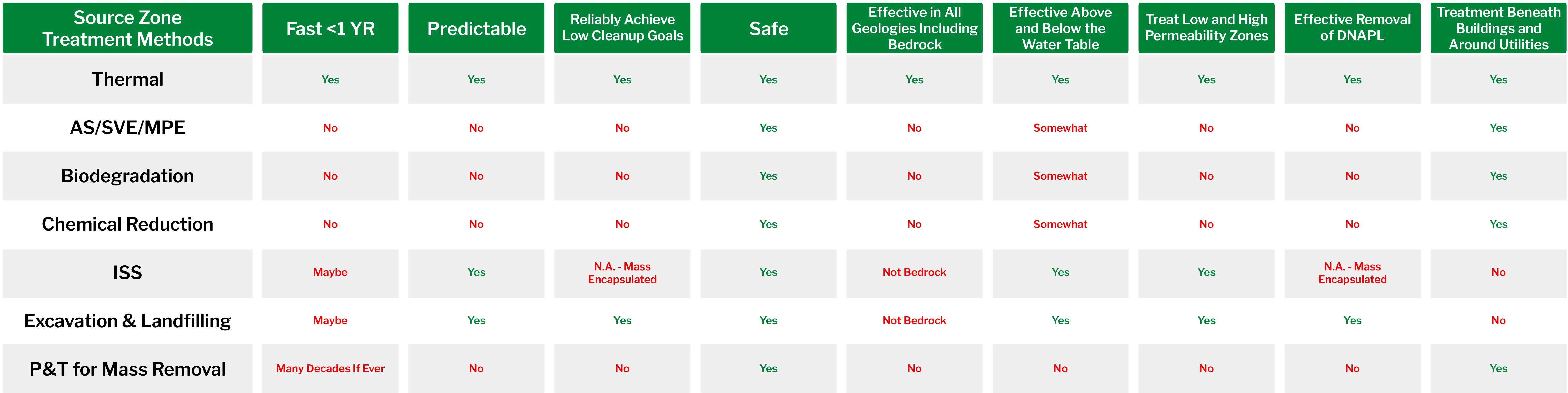
Conventional technologies such as soil vapor extraction, multiphase extraction, and groundwater pump-and-treat can effectively contain contamination and remove readily accessible mass, but may require long operating periods when significant mass, NAPL or back-diffusing contamination remains in fine-grained soil or fractured rock. Thermal remediation addresses these limitations by co-boiling NAPL, and increasing vapor pressure, diffusion, desorption, dissolution, and reaction rates within the source zone. Thermal is often most effective when integrated into a treatment train that combines source-zone treatment with lower-intensity polishing remedies for downgradient plumes.
Choosing the Right Solution
TerraTherm tailors each VOC remedy to the site and the client’s cleanup objectives. Our evaluation considers:
- Geology, soil type, permeability, and fracture characteristics
- Groundwater conditions, including flow direction, velocity, and recharge
- Treatment depth, target-zone geometry, and access constraints
- Contaminant identity, concentration, distribution, mass, and presence of DNAPL
- Co-contaminants and soil organic carbon
- Electrical resistivity and moisture conditions
- Required cleanup levels, endpoint metrics, schedule, and regulatory requirements
- Existing buildings, utilities, ongoing operations, and surrounding land use
- Energy availability, extraction and treatment needs, and sustainability objectives
TCH and ERH are both strong options for many VOC sites. Selection depends on factors such as electrical resistivity, moisture, treatment depth, site geology and heterogeneity, groundwater flow, and the need to heat competent or fractured bedrock. SEE can be advantageous in sufficiently permeable formations and can be combined with TCH or ERH where a site contains both high- and low-permeability intervals. TerraTherm’s design process matches the heat-delivery method, extraction system, and operating strategy to the conditions that control performance.
Ready to Address VOCs at Your Site?
TerraTherm applies field-proven thermal technologies and data-driven design to complex chlorinated-solvent source zones. We work with site owners, consultants, and regulators to define a practical treatment boundary, select the right heating approach, manage vapor and groundwater during operations, and verify that cleanup objectives have been achieved.
TCH Technology Applicability