PCB Remediation
What Are PCBs and Why Are They a Problem?
Polychlorinated biphenyls (PCBs) are a family of synthetic chlorinated organic compounds that were widely used in transformers, capacitors, hydraulic fluids, heat-transfer systems, paints, caulks, sealants, and other industrial products. Their chemical stability made them useful in industrial applications, but also makes them highly persistent in the environment.
Once released, PCBs strongly bind to soil, sediment, and organic matter and resist natural degradation. Depending on the source, PCBs may be present in residual dielectric oils, associated with petroleum hydrocarbons or NAPL, or sorbed to soil and sediment. PCBs can also bioaccumulate in food webs, creating long-term risks to human health and ecological receptors.
PCB cleanup and disposal requirements are governed by the Toxic Substances Control Act (TSCA), other federal and state programs, and site-specific approvals. Cleanup goals and waste-management requirements depend on the material, concentration, exposure setting, remedy, and applicable regulatory pathway.
Common Sites with PCB Contamination
- Former transformer and capacitor manufacturing facilities
- Electrical equipment storage, servicing, and spill areas
- Utility substations and power-generation facilities
- Industrial manufacturing and maintenance facilities
- Legacy disposal areas and landfills
- Sediment and floodplain areas affected by historical PCB releases
- Brownfield and industrial redevelopment properties
Thermal Remediation: An Effective and Permanent Solution
High-temperature thermal remediation applies heat to PCB-impacted soil or sediment to desorb and volatilize PCB mass for controlled capture and treatment. Unlike containment or off-site disposal, thermal treatment addresses the contaminant itself. It can reduce reliance on long-term caps, institutional controls, and shipment of TSCA-regulated PCB remediation waste to disposal facilities.
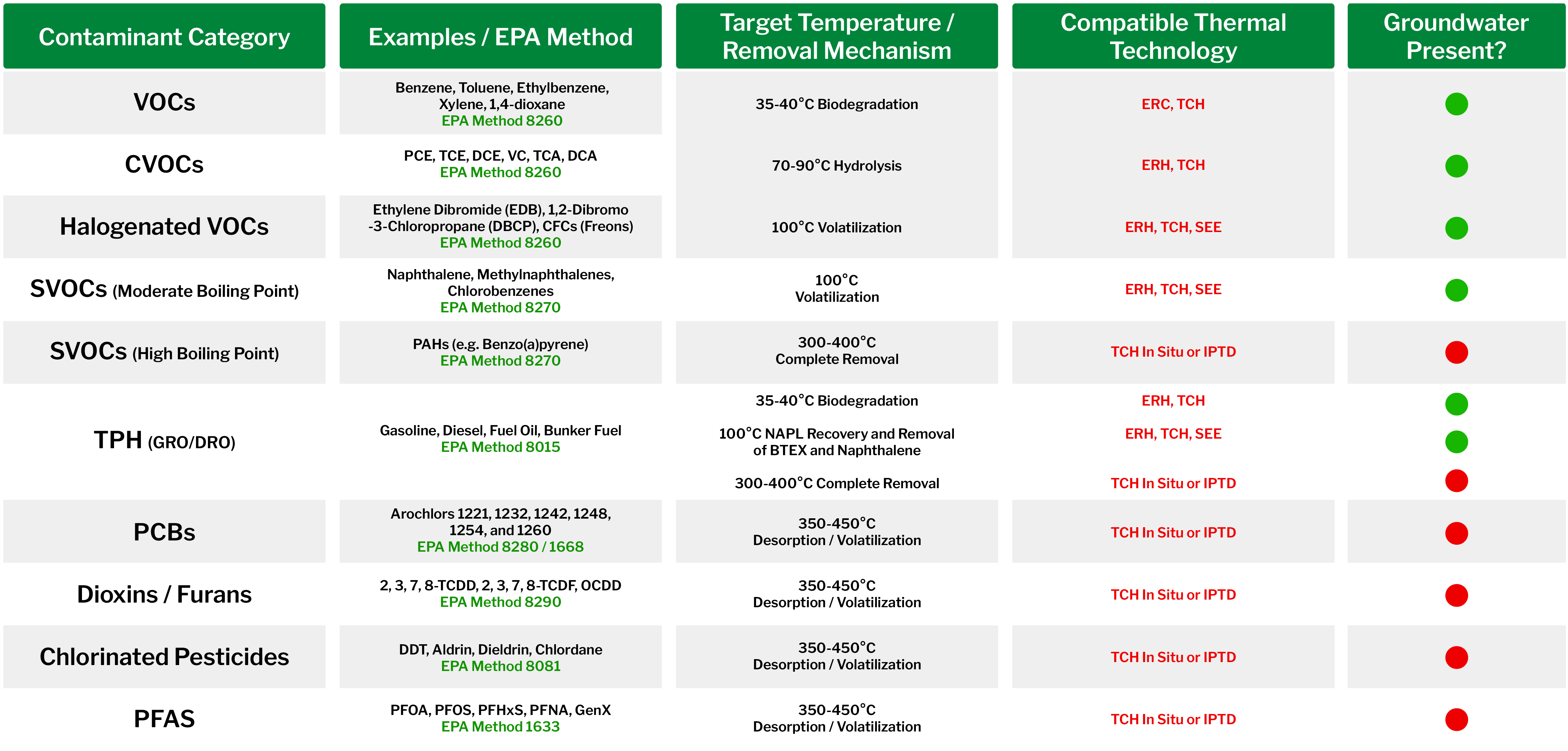
PCBs require high-temperature treatment. TerraTherm uses Thermal Conduction Heating (TCH) to raise treated soil or sediment to approximately 350 to 400°C. Vapor extraction maintains pneumatic control and transports volatilized PCBs to aboveground treatment equipment. Although some in situ degradation can occur, removal from the soil or sediment followed by aboveground destruction is the primary design basis.
High-Temperature PCB Removal and Destruction
|
Typical target temperature |
Primary mechanism |
At high temperature, PCBs desorb from soil and sediment particles and enter the vapor phase. An engineered vacuum system captures the vapors and conveys them through heated collection piping to aboveground treatment. The treatment train selected for the project may include particulate removal, thermal oxidation, rapid gas cooling, acid-gas control, activated carbon, continuous or periodic monitoring, and redundant safeguards.
The required temperature, residence time, energy input, and confirmation-sampling program are established from the PCB concentration and composition, soil or sediment properties, organic carbon, treatment-zone geometry, cleanup goals, groundwater conditions, and regulatory approval. High-temperature in situ treatment must also manage heat losses and prevent uncontrolled groundwater or surface-water recharge into the treatment zone.
|
Permanent Treatment and TSCA Disposal Avoidance On-site thermal treatment can substantially reduce or eliminate the volume of PCB-contaminated soil or sediment that must be transported to a TSCA-regulated disposal facility. This can reduce trucking, material handling, disposal dependence, and the long-term liability associated with relocating PCB waste. The applicable cleanup and disposal pathway remains subject to project-specific TSCA requirements and EPA or other regulatory approvals. |
Our Heating Solutions for PCBs
Thermal Conduction Heating (TCH)
TCH transfers heat from subsurface heaters into surrounding soil by thermal conduction. Because heat transfer does not depend on electrical current flowing through the formation, TCH can achieve the 350 to 400°C temperatures required for PCB treatment in a wide range of soil types and moisture conditions.
In situ TCH is appropriate where site conditions allow the treatment zone to be heated above the boiling point of water after pore water has been removed. Groundwater and surface-water recharge must be controlled, and an insulated vapor cover and vapor extraction system are used to limit heat loss, maintain pneumatic control, and capture volatilized contaminants. In situ treatment can be especially valuable where excavation would be disruptive or where PCB impacts extend beneath infrastructure.
In-Pile Thermal Desorption (IPTD®)
IPTD applies TCH within a fully covered, insulated, and engineered aboveground treatment pile. Excavated soil or sediment is placed in the pile and heated uniformly to the temperature required for PCB removal. Vapors are captured under vacuum and routed to aboveground treatment for destruction.
IPTD can treat both soil and sediment. It is a strong option when excavation is already planned, sediments must be removed, impacts are shallow, groundwater or surface-water conditions make in situ high-temperature treatment impractical, or site redevelopment requires controlled material management. Treating material on site can reduce or avoid transportation and disposal of TSCA-regulated PCB waste while returning treated material to a condition suitable for the approved end use.
Will Thermal Work for Your Site?
Tell us about your site and we'll tell you whether thermal treatment applies and which approach fits. If it isn't the right remedy, we'll say so.
How Does Thermal Compare to Other Methods?
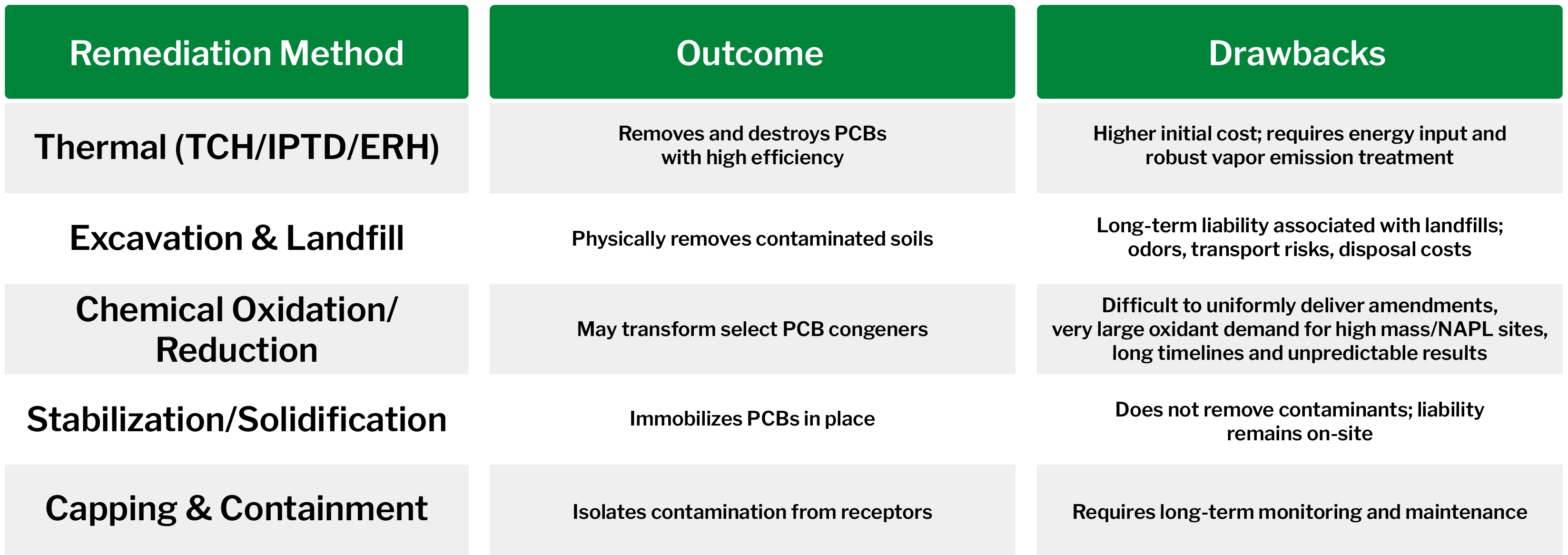
Conventional PCB remedies commonly include excavation and off-site disposal, capping, containment, dredging, stabilization, and institutional controls. These methods can manage exposure, but may relocate PCB waste or leave contaminant mass in place with continuing inspection, monitoring, maintenance, and land-use obligations.
Thermal remediation removes PCB mass from soil or sediment and destroys the recovered contaminants in a controlled aboveground treatment system. Where technically and regulatorily appropriate, it can provide permanent mass reduction, reduce dependence on disposal capacity, limit off-site transportation, and support property reuse. Thermal is not the best fit for every site, but it can be particularly valuable where disposal volumes, long-term liability, difficult access, or stringent cleanup goals drive remedy selection.
Choosing the Right Solution
TerraTherm tailors each PCB remedy to the site and the client’s cleanup objectives. Our evaluation considers:
- PCB concentration, Aroclor or congener profile, and spatial distribution
- Soil or sediment type, organic carbon, moisture, and thermal properties
- PCB-containing oils, NAPL, debris, and co-contaminants
- Treatment depth, volume, geometry, and access constraints
- Groundwater and surface-water conditions and the ability to control recharge
- TSCA pathway, site-specific approvals, cleanup criteria, and confirmation sampling
- Redevelopment plans, schedule, material handling, and approved beneficial reuse or disposition
- Power availability, vapor-treatment requirements, emissions limits, and sustainability objectives
In situ TCH is selected when PCB-impacted soil can be heated safely and uniformly and water influx can be controlled. IPTD is selected when soil or sediment can be excavated and treated more efficiently in an engineered pile. TerraTherm’s design process aligns the treatment configuration, target temperature, vapor controls, aboveground destruction system, and verification program with the site-specific technical and regulatory requirements.
|
Why TerraTherm? TerraTherm’s PCB project experience includes in situ and ex situ applications using high-temperature conductive heating. At the Missouri Electric Works Superfund Site in Cape Girardeau, Missouri, a 47-m³ treatment reduced a reported maximum pretreatment PCB concentration of 20,000 mg/kg to a reported post-treatment mean below 0.033 mg/kg, with a reported >99.999999% total system destruction and removal efficiency. At the General Electric South Glens Falls, New York project, a 12.2-m³ treatment reduced a reported maximum pretreatment concentration of 5,000 mg/kg to a reported post-treatment mean below 0.8 mg/kg. Additional projects included PCB treatment for the U.S. Navy at Vallejo and Ferndale, California, and for the U.S. Army Corps of Engineers at Tanapag, Saipan. These projects demonstrate the application of high-temperature conductive heating to PCB-impacted soils under varied site conditions and cleanup objectives. |
Ready to Remediate PCBs at Your Site?
TerraTherm applies field-proven high-temperature thermal technologies and data-driven design to PCB-impacted soil and sediment. We work with site owners, consultants, utilities, industrial operators, and regulators to evaluate in situ and IPTD options, define practical treatment boundaries, reduce dependence on TSCA-regulated disposal, manage vapor and water during treatment, and verify that cleanup objectives have been achieved.
TCH Technology Applicability