Creosote & Coal Tar Remediation
What Are Creosote and Coal Tar, and Why Are They a Problem?
Coal tar is a viscous oily byproduct of historical coal gasification at manufactured gas plant (MGP) sites and coke production at steel plants. It is a complex mixture of volatile organic compounds (VOCs), semi-volatile organic compounds (SVOCs), polycyclic aromatic hydrocarbons (PAHs), petroleum hydrocarbons, and heavier residues such as coal tar pitch.
Creosote, or coal tar creosote, is a coal tar distillate used primarily to preserve railroad ties, utility poles, marine pilings, and other wood products. Creosote and coal tar are not single chemicals. They contain hundreds to thousands of constituents with widely different volatilities, solubilities, and boiling points.
At former MGP and wood-treating sites, releases commonly entered the subsurface as dense non-aqueous phase liquid (DNAPL). The viscous material can migrate along small-scale geologic pathways, pool above low-permeability layers, penetrate fractured rock, and bind strongly to soil and organic matter. Large releases can remain persistent sources of BTEX, naphthalene, other PAHs, and petroleum hydrocarbons to groundwater and soil gas for decades.
Common Sites with Creosote and Coal Tar Contamination
- Former manufactured gas plant (MGP) sites and gas-holder areas
- Wood-treating and timber-preservation facilities
- Railroad tie and utility pole treatment yards
- Marine piling and waterfront wood-treatment facilities
- Steel manufacturing and coking operations
- Historical coal processing, tar storage, and disposal areas
Thermal Remediation: A Reliable Solution for Creosote and Coal Tar Source Zones
In situ thermal remediation applies heat directly to contaminated soil, groundwater, and rock to mobilize, recover, remove, and destroy coal tar and creosote. Unlike conventional recovery or injection-based remedies alone, thermal treatment can address large contaminant masses, viscous DNAPL, low-permeability storage zones, and complex mixtures containing both volatile and high-boiling compounds.
TerraTherm uses three levels of treatment, sometimes sequentially, to match the heating strategy to site-specific remedial goals. A project may stop after enhanced product recovery, continue to boiling-point treatment for removal of mobile VOCs and lighter SVOCs, or advance to high-temperature treatment for comprehensive removal and destruction of PAHs, TPH, creosote, and coal tar.
Level 1 Treatment: Thermally Enhanced NAPL Recovery
|
Typical target temperature |
Primary mechanism |
Level 1 treatment gently heats the source zone to reduce the viscosity of coal tar or creosote, making the NAPL more mobile and pumpable. Multiphase extraction is used during heat-up to recover product, groundwater, and vapor while maintaining hydraulic and pneumatic control. This approach is well suited to sites where the primary objective is recovery of mobile product and reduction of source mass.
Temperature and heating rate are carefully managed. If lighter constituents are removed too rapidly, the remaining NAPL can become more viscous and less recoverable. Level 1 operations therefore balance heat delivery with product recovery to capture as much mobile NAPL as practical before advancing to the next treatment level or ending treatment.
Level 2 Treatment: Boiling-Point Removal and Thermal-Chemical Weathering
|
Typical target temperature |
Primary mechanism |
Level 2 treatment heats the source zone to the boiling point of water. Steam generated in the formation strips BTEX and lighter SVOCs, including naphthalene and methylnaphthalenes, from soil, groundwater, and NAPL. These contaminants are transferred to the vapor phase, captured by extraction wells, and treated aboveground. Mobile NAPL and impacted groundwater may also be recovered through multiphase extraction.
The required energy input and operating duration depend on the target compounds, initial mass, soil organic carbon, groundwater inflow, cleanup goals, and desired reduction in leachability. Level 2 treatment may follow Level 1 product recovery or be implemented as the primary remedy when the objective is to remove mobile and leachable fractions that drive groundwater and vapor risks.
|
Thermal-Chemical Weathering As BTEX, naphthalene, and other lighter fractions are removed, the remaining coal tar becomes more viscous and asphalt-like. This thermal-chemical weathering can greatly reduce NAPL mobility and the potential for residual material to leach mobile constituents to groundwater. The result is not simply mass removal. It is a fundamental change in the physical and chemical behavior of the remaining source material. |
Level 3 Treatment: High-Temperature Removal and Destruction
|
Typical target temperature |
Primary mechanism |
Level 3 treatment is used when remedial goals require substantial removal and destruction of creosote, coal tar, PAHs, and heavier-range TPH. After pore water is removed via boil-off, TCH raises soil temperatures to approximately 300 to 350°C. At these temperatures, high-boiling contaminants desorb and volatilize for vapor recovery, while oxidation and pyrolysis destroy a portion of the contaminant mass in situ.
At some MGP sites, the heat, oxygen supply, and fuel characteristics can also support controlled smoldering of coal tar and creosote. When conditions are amenable and the system is designed and monitored for this behavior, smoldering can contribute to the in situ destruction of PAHs, TPH, and residual NAPL. Vapor extraction and aboveground treatment remain integral to maintaining pneumatic control and managing recovered vapors.
Level 3 provides the most complete treatment. It can incorporate Level 1 product recovery during heat-up, Level 2 removal and weathering of volatile and lighter semi-volatile fractions near the boiling point, and high-temperature removal and destruction of the remaining PAHs, TPH, creosote, and coal tar.
Our Thermal Solutions
Electrical Resistance Heating (ERH)
ERH passes alternating electrical current through moist soil and groundwater between subsurface electrodes. Electrical resistance converts energy to heat within the treatment zone. ERH can be used for Level 1 enhanced NAPL recovery and Level 2 boiling-point treatment in many heterogeneous formations with sufficient moisture and electrical conductivity.
ERH performance depends on site-specific electrical resistivity, moisture, groundwater flow, and the ability to maintain balanced power input. Vapor and multiphase extraction are used as needed to recover contaminants and maintain pneumatic and hydraulic control. Because ERH is limited to operating at or below the boiling point of water, it is not used for Level 3 treatment at 300 to 350°C.
Thermal Conduction Heating (TCH)
TCH transfers heat from subsurface heaters into surrounding soil and rock by thermal conduction. Because it does not depend on formation moisture or electrical current flowing through the subsurface, TCH can be applied in wet or dry soil, above or below the water table, and in fractured rock. Its predictable heat transfer makes TCH suitable for all three treatment levels.
TCH can gently heat a source zone for Level 1 NAPL recovery, maintain boiling-point conditions for Level 2 mass removal and thermal-chemical weathering, or reach the 300 to 350°C temperatures required for Level 3 removal and destruction. For high-temperature in situ treatment, groundwater and surface-water influx must be controlled so that the energy delivered to the subsurface can raise the soil above the boiling point after pore water has been removed.
Steam Enhanced Extraction (SEE)
SEE injects steam into permeable saturated formations to deliver heat rapidly, mobilize NAPL, and strip VOCs and lighter SVOCs. It is generally best suited to sands, gravels, permeable fill, and highly fractured bedrock systems that can distribute steam effectively. SEE can support Level 2 treatment objectives but cannot raise saturated soil above the steam temperature needed for Level 3 treatment.
Condensed steam adds water to the treatment zone, so a carefully designed multiphase extraction network is required to recover vapor, groundwater, and NAPL and to maintain pneumatic and hydraulic control. At heterogeneous MGP sites, SEE can be combined with ERH or TCH so that steam treats permeable intervals while conductive or resistive heating addresses lower-permeability zones.
In-Pile Thermal Desorption (IPTD®)
IPTD uses TCH to treat excavated soil and sediment in a fully covered, insulated, and engineered aboveground pile. The system provides uniform high-temperature treatment and complete vapor capture while avoiding off-site transportation and disposal of contaminated material and associated risks and liability.
For creosote, coal tar, PAHs, and heavier TPH, IPTD can heat material to approximately 300 to 350°C for removal and destruction. It is a strong option when contaminated soil is already being excavated, groundwater influx makes high-temperature in situ treatment impractical, redevelopment requires rapid soil management, or on-site treatment is preferred to long-term landfill liability.
Will Thermal Work for Your Site?
Tell us about your site and we'll tell you whether thermal treatment applies and which approach fits. If it isn't the right remedy, we'll say so.
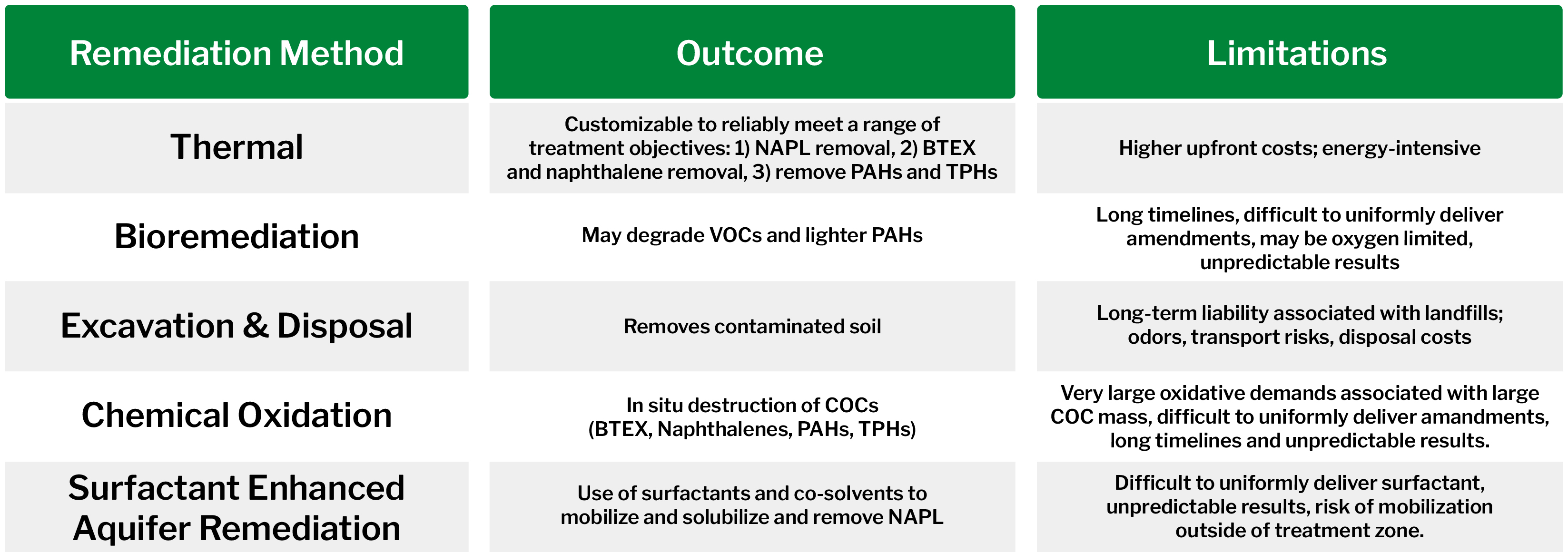
How Does Thermal Compare to Other Methods?
Choosing the Right Solution
TerraTherm tailors each creosote and coal tar remedy to the site and the client’s cleanup objectives. Our evaluation considers:
- MGP structures, gas holders, foundations, utilities, and redevelopment plans
- Geology, permeability, fractures, and soil thermal properties
- Groundwater elevation, flow, recharge, and the ability to control influx
- Treatment depth, target-zone geometry, and access constraints
- Coal tar or creosote distribution, viscosity, mobility, and degree of weathering
- Target VOCs, SVOCs, PAHs, TPH, and co-contaminants
- Required cleanup levels, leachability goals, endpoint metrics, and schedule
- Electrical power, fuel, extraction capacity, and aboveground treatment needs
- Opportunities to combine thermal remediation with polishing remedies
Level 1 is selected when enhanced NAPL recovery is the primary objective. Level 2 is used to remove BTEX and lighter SVOCs and to reduce the mobility and leachability of residual coal tar through thermal-chemical weathering. Level 3 is used when the remedy requires the most comprehensive removal and destruction of PAHs, TPH, creosote, and coal tar. TerraTherm selects the heating and extraction technologies that can achieve the required treatment level under the site’s actual geologic, hydrogeologic, and operational constraints.
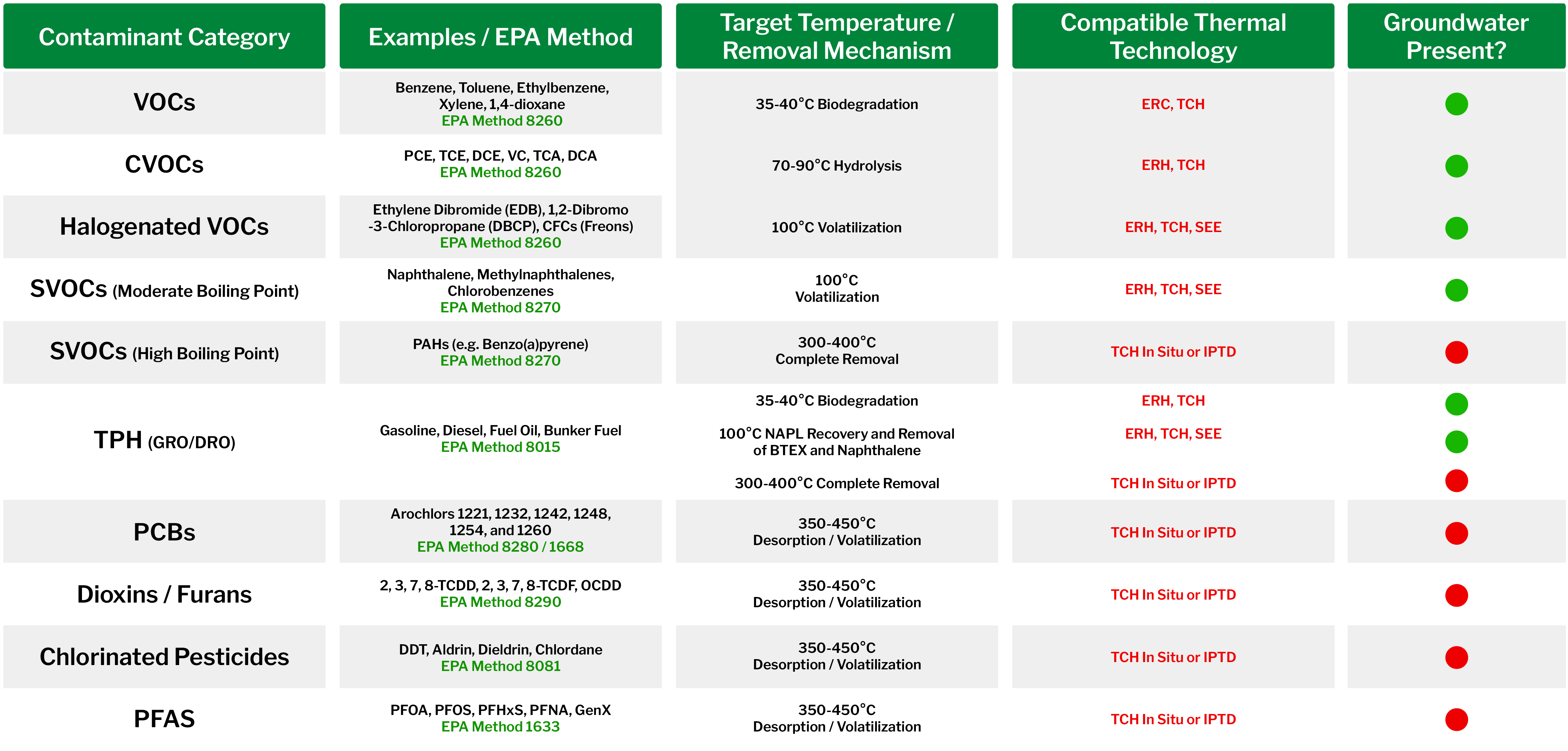
TCH Technology Applicability
Why TerraTherm?
TerraTherm has applied thermal remediation to manufactured gas plant, creosote, and coal tar source zones using the full Level 1, Level 2, and Level 3 treatment framework. Our project experience includes recovery of more than 16,000 gallons of coal tar and extraction and treatment of more than 166,000 pounds of contaminants at a former MGP gas holder (North Adams), where no DNAPL remained and remedial goals were achieved. At another deep, infrastructure-constrained MGP site, a combined TCH and SEE remedy treated contamination extending to approximately 140 feet below ground surface with confirmation sampling indicatign an approximately 95 percent reduction in total contaminant mass (Hastings). This field experience helps clients align treatment intensity with cleanup goals, manage high contaminant mass, and prepare complex properties for continued use or redevelopment.
Ready to Address Creosote or Coal Tar at Your Site?
TerraTherm applies field-proven thermal technologies and data-driven design to complex MGP, creosote, and coal tar source zones. We work with site owners, consultants, and regulators to define the right treatment level, select the appropriate heating and extraction approach, manage groundwater and vapor during operations, and verify that cleanup objectives have been achieved.

