SVOCs: PAH, PCP, Dioxins, Furans, and Chlorinated Pesticides Remediation
What Are PAHs, PCP, Dioxins, Furans, and Chlorinated Pesticides, and Why Are They a Problem?
Semi-volatile organic compounds (SVOCs) are a broad group of organic chemicals with lower volatility and generally higher boiling points than volatile organic compounds. Polycyclic aromatic hydrocarbons (PAHs) are an important subgroup composed of fused aromatic rings. Common examples include naphthalene, phenanthrene, pyrene, chrysene, and benzo[a]pyrene.
This broad contaminant class also includes pentachlorophenol (PCP), chlorinated pesticides, polychlorinated dibenzodioxins (dioxins), and polychlorinated dibenzofurans (furans). These persistent compounds are often associated with wood treatment, chemical manufacturing, combustion residues, waste oils, pesticides, coal tar, creosote, and industrial waste. Many strongly bind to soil, sediment, and organic matter and resist natural degradation.
Coal tar and creosote are major sources of PAHs and other SVOCs. For detailed information on these complex NAPL mixtures and TerraTherm’s three-level treatment framework, visit the Creosote & Coal Tar Remediation page.
Common Sites with SVOC, PAH, PCP, and Dioxin Contamination
- Former manufactured gas plant sites
- Wood-treatment and timber-preservation facilities
- Petroleum refineries, terminals, and bulk-storage areas
- Coking, steelmaking, and combustion-related facilities
- Chemical manufacturing and pesticide-handling facilities
- Industrial fill, disposal areas, and landfills
- Sediments affected by industrial discharges or historical releases
Thermal Remediation: A Reliable Solution for Impacted Soil and Sediment
High-temperature thermal remediation applies heat to contaminated soil or sediment to desorb and volatilize SVOCs, PAHs, PCP, dioxins, furans, and chlorinated pesticides for controlled capture and treatment. It directly addresses contaminant mass and can overcome limitations caused by strong sorption, low bioavailability, high organic loading, low-permeability soils, and nonuniform amendment delivery.
TerraTherm uses Thermal Conduction Heating (TCH) to achieve the temperatures required for these persistent contaminants. Vapor extraction maintains pneumatic control and conveys recovered contaminants to aboveground treatment. Although oxidation and pyrolysis may destroy a portion of the mass in situ, removal followed by aboveground treatment and destruction is the primary design basis.
High-Temperature Removal and Destruction
|
Typical target temperature |
Primary mechanism |
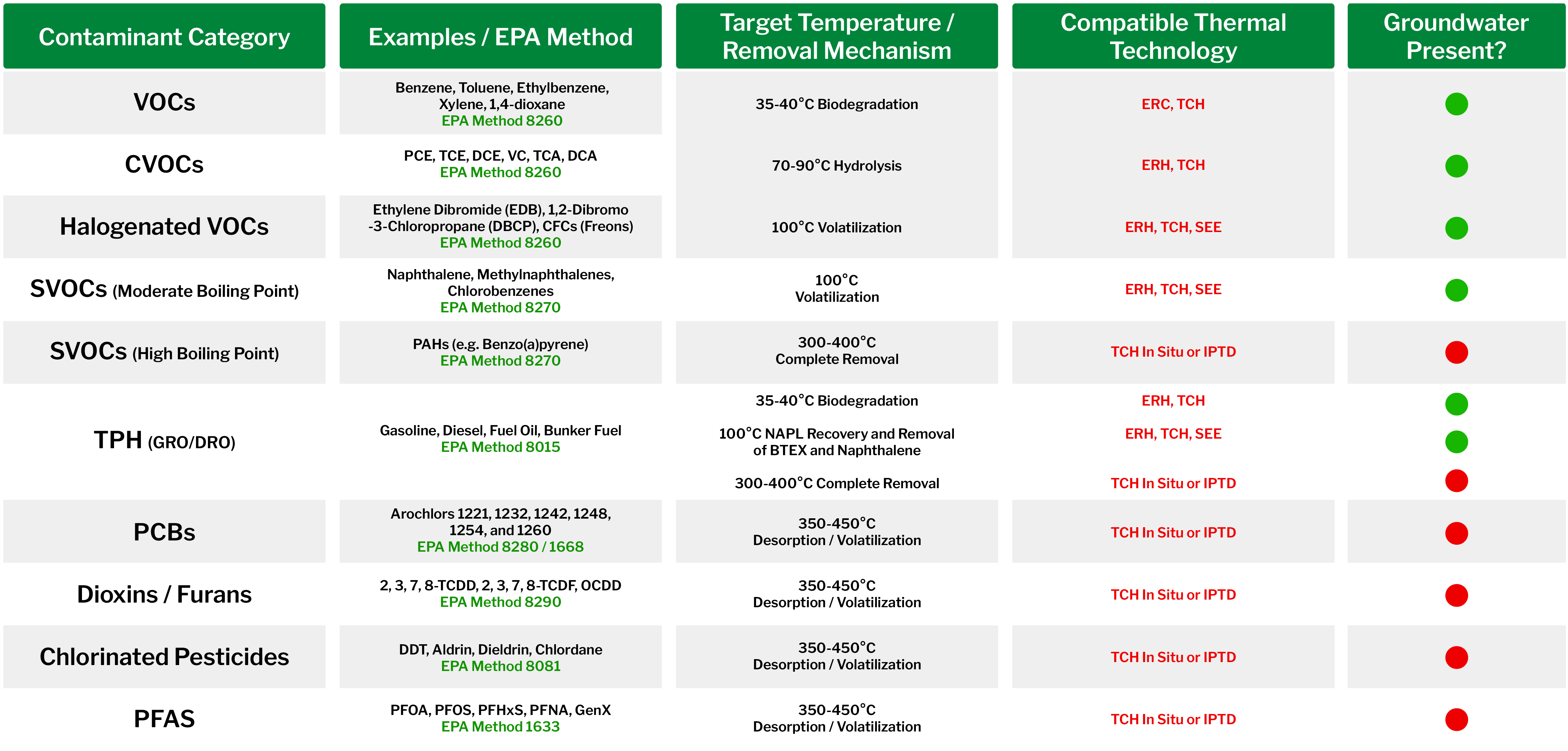
At approximately 300 to 400°C, SVOCs desorb from soil and sediment and enter the vapor phase. An engineered vacuum system captures the vapors and conveys them through heated piping to keep them in the vapor phase so they can be conveyed to a project-specific treatment train. Higher-molecular-weight PAHs, PCP, dioxins, furans, and chlorinated pesticides require sufficient time at temperature to achieve stringent cleanup goals.
Treatment temperature, residence time, energy input, and confirmation sampling are based on target compounds, initial concentrations, soil and sediment properties, organic carbon, treatment geometry, cleanup goals, groundwater conditions, and vapor-treatment requirements. High-temperature in situ treatment must also limit heat loss and control and eliminate groundwater or surface-water recharge.
|
A Treatment Strategy Matched to the Contaminant Mixture SVOCs span a wide range of physical and chemical properties. TerraTherm establishes the design temperature and operating endpoint around the most difficult compounds that must meet cleanup goals rather than applying one temperature to every site. Coal tar and creosote may also be treated using lower-temperature recovery or weathering steps; those strategies are addressed on the linked Creosote & Coal Tar page. |
Our Heating Solutions
Thermal Conduction Heating (TCH)
TCH transfers heat from subsurface heaters into surrounding soil or rock by thermal conduction. It can achieve high treatment temperatures in wet or dry soil, low-permeability formations, and fractured rock. TCH is the primary in situ technology when high-molecular-weight PAHs, PCP, dioxins, furans, chlorinated pesticides, or other persistent SVOCs require temperatures well above the boiling point of water.
In situ TCH is appropriate where the treatment zone can be heated safely and uniformly and water influx can be controlled. An insulated vapor cover and vapor extraction system limit heat loss, maintain pneumatic control, and capture volatilized contaminants.
In-Pile Thermal Desorption (IPTD®)
IPTD applies TCH within a fully covered, insulated, engineered aboveground pile. Excavated soil or sediment is heated uniformly while vapors are captured under vacuum and routed to aboveground treatment. IPTD can achieve the temperatures required for PAHs and other persistent SVOCs under highly controlled conditions.
IPTD is a strong option when excavation is already planned, sediments require treatment, impacts are shallow, groundwater makes high-temperature in situ heating impractical, or redevelopment requires controlled material management. On-site treatment can reduce transportation and landfill disposal while allowing treated material to be managed according to project-specific approvals.
How Does Thermal Compare to Other Methods?
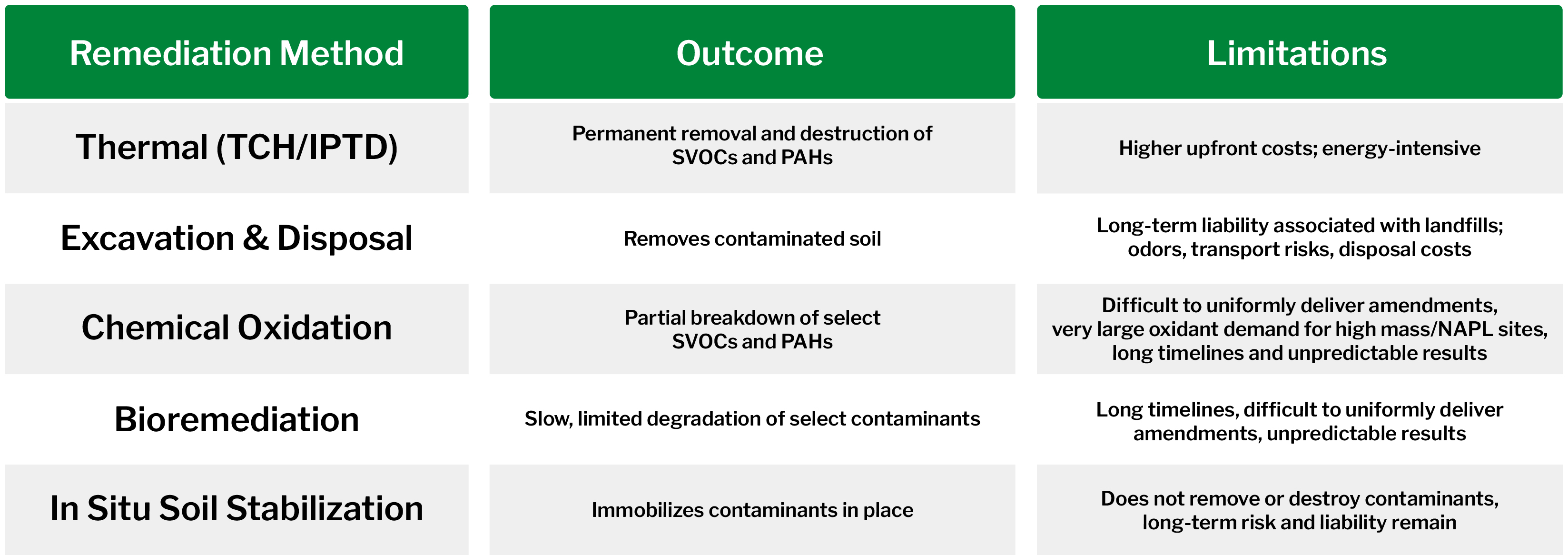
Conventional remedies include excavation and disposal, capping, containment, soil washing, bioremediation, and chemical oxidation. These approaches can be effective under appropriate conditions, but may be constrained by strong sorption, low bioavailability, large contaminant mass, NAPL, high oxidant demand, difficult amendment delivery, or long-term management obligations.
Thermal remediation increases vapor pressure, desorption, diffusion, and mass-transfer rates and can remove compounds tightly bound to soil or sediment. Where appropriate, it can provide permanent mass reduction, reduce disposal dependence, and support property reuse. Thermal may also be combined with lower-intensity polishing remedies outside the heated source area.
Will Thermal Work for Your Site?
Tell us about your site and we'll tell you whether thermal treatment applies and which approach fits. If it isn't the right remedy, we'll say so.
How Does Thermal Compare to Other Methods?
Choosing the Right Solution
TerraTherm tailors each remedy to the site and cleanup objectives. Our evaluation considers:
- Target compounds, concentrations, vapor pressures, and spatial distribution
- Soil or sediment type, organic carbon, moisture, and thermal properties
- Presence of NAPL, petroleum hydrocarbons, coal tar, creosote, and other co-contaminants
- Treatment depth, volume, geometry, and access constraints
- Groundwater and surface-water conditions and control of recharge
- Cleanup goals, endpoint metrics, and confirmation sampling
- Redevelopment plans, schedule, material handling, vapor treatment, and emissions limits
TCH is selected when high temperatures are required for high-molecular-weight PAHs, PCP, dioxins, furans, chlorinated pesticides, or other strongly sorbed SVOCs. ERH and Steam Enhanced Extraction may support treatment of lighter SVOCs and associated VOCs where moisture, electrical conductivity, and permeability are favorable, but they cannot achieve the approximately 300 to 400°C temperatures required for the most recalcitrant targets. IPTD is selected when soil or sediment can be excavated and treated more effectively in an engineered pile.
|
Why TerraTherm? At the former Southern California Edison wood-treatment facility in Alhambra, California, TerraTherm used high-temperature in situ TCH to treat approximately 12,385 m³ (16,200 cubic yards) of soil impacted by PAHs, PCP, dioxins, and furans to a maximum depth of approximately 32 m (105 ft). Mean carcinogenic PAHs, expressed as benzo[a]pyrene equivalents, were reduced from 30.6 mg/kg to 0.059 mg/kg, meeting the 0.065 mg/kg cleanup standard. Mean dioxins and furans were reduced from 18 µg/kg TEQ to 0.11 µg/kg TEQ, below the 1 µg/kg goal, and PCP was not detected at or above the 2.5 mg/kg remediation goal. The California Department of Toxic Substances Control certified the area for unrestricted land use and no further action. |
Ready to Address SVOCs, PAHs, PCP, or Dioxins at Your Site?
TerraTherm applies field-proven thermal technologies and data-driven design to impacted soil, sediment, and source zones. We work with site owners, consultants, industrial operators, and regulators to define treatment boundaries, select the appropriate temperature and technology, manage vapor and water, and verify that cleanup objectives have been achieved.
TCH Technology Applicability