TPH Remediation Services
What Are TPHs and Why Are They a Problem?
Total petroleum hydrocarbons (TPH) is a broad term used to describe the hundreds of hydrocarbon compounds derived from crude oil and refined petroleum products. TPH contamination commonly includes overlapping fractions that differ widely in volatility, mobility, persistence, and toxicity: gasoline-range organics (GRO), diesel-range organics (DRO), and oil-range organics (ORO).
Petroleum releases may contain benzene, toluene, ethylbenzene, and xylenes (BTEX); naphthalene and other polycyclic aromatic hydrocarbons (PAHs); diesel and jet fuel; lubricating and hydraulic oils; and weathered petroleum residues. Once released, these hydrocarbons can form light non-aqueous phase liquid (LNAPL), dissolve into groundwater, partition into soil gas, and remain long-term sources of groundwater impacts and vapor intrusion.
Common Sites with TPH Contamination
- Gas stations and petroleum bulk-storage terminals
- Fueling depots, railyards, and transportation corridors
- Petroleum refineries and chemical-processing facilities
- Military installations and aviation-fueling facilities
- Pipeline and transfer-system release locations
- Industrial sites with aboveground or underground storage tanks
- Brownfield and industrial redevelopment properties
Thermal Remediation: A Reliable Solution for TPH Source Zones
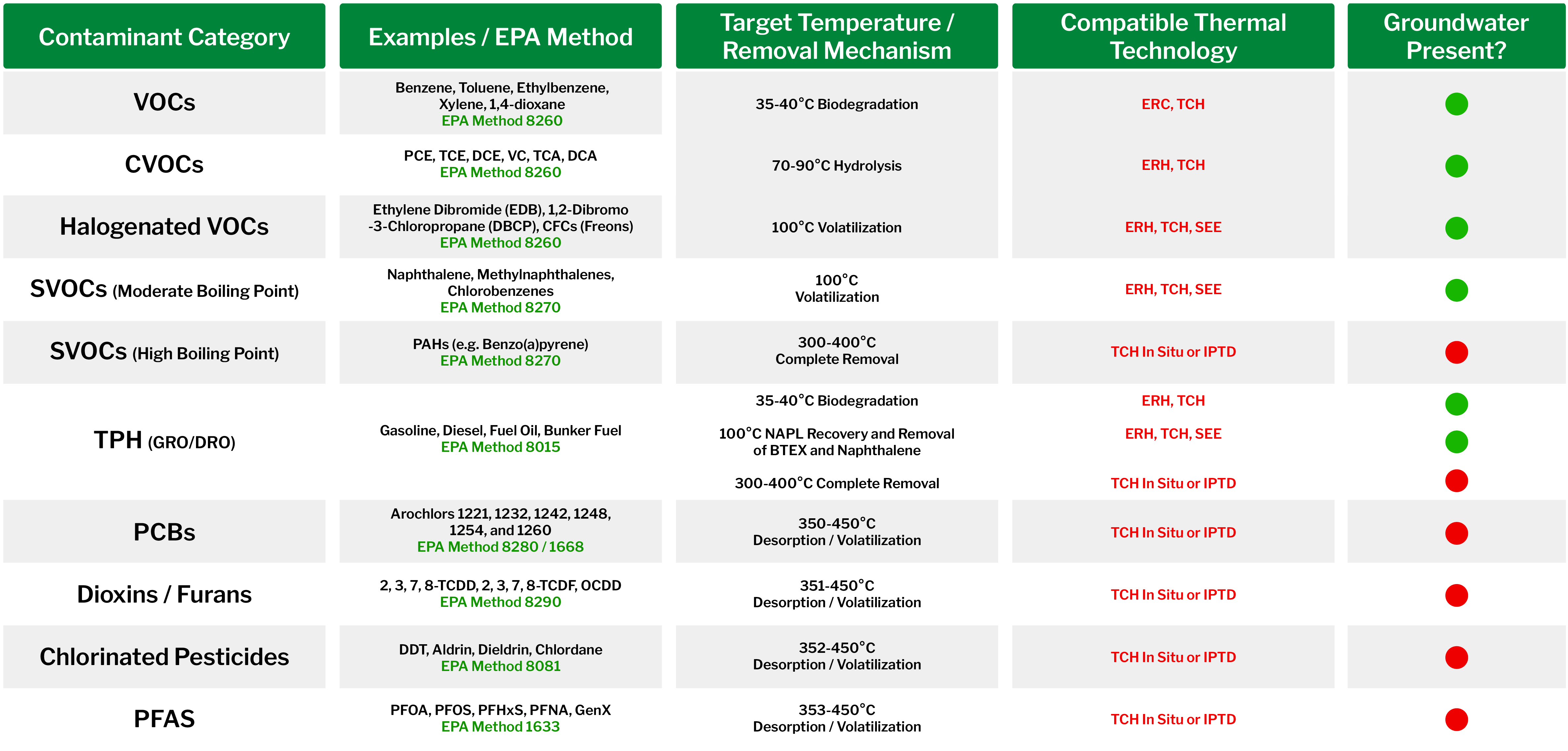
Thermal remediation applies controlled heat directly to contaminated soil, groundwater, and fractured rock to accelerate biodegradation or to mobilize, recover, remove, and destroy petroleum contaminant mass. Unlike approaches focused on a single fraction, thermal treatment can be tailored to source zones containing LNAPL, volatile hydrocarbons, lighter SVOCs, PAHs, and heavier weathered petroleum residues.
TerraTherm uses three treatment levels, sometimes sequentially, to match the heating strategy to the site and remedial objectives. Level 1 accelerates biological degradation. Level 2 enhances LNAPL recovery and removes BTEX and lighter petroleum fractions near the boiling point of water. Level 3 applies high-temperature treatment for comprehensive removal and destruction of PAHs and heavier-range TPH.
Level 1 Treatment: Thermally Enhanced Bioremediation
|
Typical target temperature |
Primary mechanism |
Level 1 uses low-temperature heating to establish conditions that can accelerate microbial degradation of petroleum hydrocarbons. Low-profile heaters can warm the target interval uniformly while oxygen-release compounds, electron acceptors, nutrients, or other amendments are delivered through nearby or shared installation locations.
The optimum temperature depends on the microbial community, petroleum mixture, amendment program, geochemistry, and cleanup goals. Vapor control and monitoring requirements are evaluated site by site rather than assumed unnecessary. This approach is best suited to contamination that remains biologically treatable and does not require rapid physical removal of a large LNAPL source.
Level 2 Treatment: Enhanced LNAPL Recovery and Boiling-Point Removal
|
Typical target temperature |
Primary mechanism |
Level 2 reduces petroleum viscosity, making LNAPL more mobile and recoverable through multiphase extraction. As the treatment zone approaches the boiling point of water, generated steam strips BTEX, naphthalene, and other lighter petroleum constituents from soil, groundwater, and product. Vapors are captured and treated aboveground, while mobile product and impacted water may be recovered through multiphase extraction.
The required energy input and operating duration depend on the petroleum mixture, initial mass, soil organic carbon, groundwater inflow, cleanup goals, and desired reduction in source strength. Level 2 can follow enhanced product recovery or serve as the primary remedy where mobile and leachable fractions drive groundwater or vapor risks.
|
Thermal-Chemical Weathering As BTEX, naphthalene, and other lighter fractions are removed, the remaining petroleum product becomes heavier, more viscous, and less mobile. This thermal-chemical weathering can reduce LNAPL mobility, leachability, and vapor generation. The result is both mass removal and a change in the physical and chemical behavior of the residual source material. |
Level 3 Treatment: High-Temperature Removal and Destruction
|
Typical target temperature |
Primary mechanism |
Level 3 is used when cleanup objectives require substantial removal and destruction of PAHs, heavier petroleum hydrocarbons, and weathered residual oils. After pore water is removed, TCH raises soil temperatures to approximately 300 to 350°C. High-boiling contaminants desorb and volatilize for vapor recovery, while oxidation, pyrolysis, and, where conditions are amenable, controlled smoldering can destroy a portion of the contaminant mass in situ.
Level 3 provides the most comprehensive treatment. It incorporates product recovery during heat-up and removal of VOCs and lighter SVOCs near the boiling point before progressing to high-temperature treatment of the remaining PAHs and heavier TPH. Vapor extraction and aboveground treatment remain integral to pneumatic control and contaminant management.
Our Heating Solutions for TPH
Electrical Resistance Heating (ERH)
ERH passes alternating electrical current through moist soil and groundwater between electrodes. Electrical resistance generates heat within the treatment zone. ERH can support Level 1 treatment and Level 2 LNAPL recovery and boiling-point removal where moisture and electrical conductivity are sufficient. It is not used for Level 3 treatment because formation temperatures are generally limited to the boiling point of water.
Thermal Conduction Heating (TCH)
TCH transfers heat from subsurface heaters into surrounding soil and rock by thermal conduction. It does not depend on electrical current flowing through the formation and can be applied in wet or dry soil, low-permeability formations, and fractured rock. TCH can deliver the full range of temperatures used for all three TPH treatment levels.
For high-temperature in situ treatment, groundwater and surface-water influx must be controlled so the soil can be heated above the boiling point after pore water is removed. Vapor and multiphase extraction are incorporated as needed to recover contaminants and maintain pneumatic and hydraulic control.
Steam Enhanced Extraction (SEE)
SEE injects steam into permeable saturated formations to rapidly heat the treatment zone, mobilize LNAPL, and strip BTEX and lighter SVOCs. It is best suited to sands, gravels, permeable fill, and connected fractures that can distribute steam effectively. Condensed steam adds water, so multiphase extraction is required to recover vapor, groundwater, and product and maintain control.
SEE can be combined with ERH or TCH at heterogeneous sites. Steam can efficiently treat permeable saturated intervals, while ERH or TCH addresses lower-permeability portions of the source zone. SEE cannot provide the approximately 300 to 350°C temperatures required for Level 3 treatment.
In-Pile Thermal Desorption (IPTD®)
IPTD uses TCH to treat excavated soil or sediment in a fully covered, insulated, engineered aboveground pile. The material is heated uniformly while vapors are captured under vacuum and routed to aboveground treatment. IPTD can achieve the temperatures needed to remove and destroy PAHs and heavier-range TPH.
IPTD is a strong option when excavation is planned, impacts are shallow, groundwater influx makes high-temperature in situ treatment impractical, or redevelopment requires controlled material management. On-site treatment can reduce transportation and landfill disposal while allowing treated material to be managed according to project-specific cleanup criteria and approvals.
Will Thermal Work for Your Site?
Tell us about your site and we'll tell you whether thermal treatment applies and which approach fits. If it isn't the right remedy, we'll say so.
How Does Thermal Compare to Other Methods?
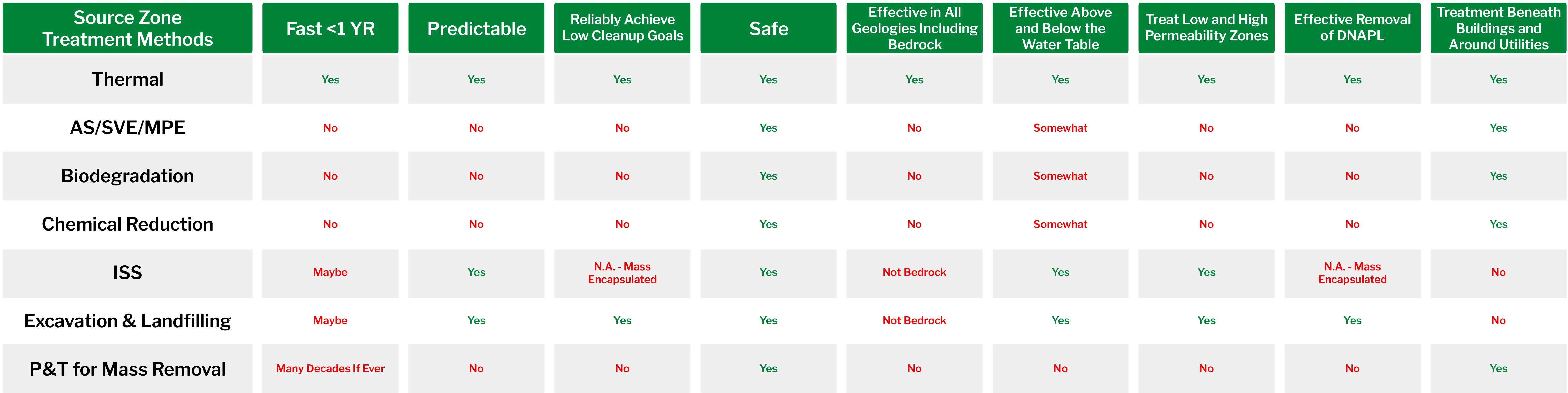
Conventional petroleum remedies include ambient-temperature bioremediation, soil vapor extraction, air sparging, chemical oxidation, product recovery, and excavation with disposal. These methods can be effective under appropriate conditions, but may be limited by large source mass, low-permeability soil, weathered product, high oxidant demand, nonuniform flow or amendment delivery, and long operating periods.
Thermal remediation allows treatment intensity to be matched to the objective. Low-temperature heating can accelerate biodegradation, moderate-temperature heating can improve product recovery and remove volatile and lighter semi-volatile fractions, and high-temperature treatment can remove and destroy persistent PAHs and heavier hydrocarbons. Thermal can serve as a focused source-zone remedy or as part of a treatment train with lower-intensity polishing technologies.
Choosing the Right Solution
TerraTherm tailors each TPH remedy to the site and the client’s cleanup objectives. Our evaluation considers:
- Mass of GRO, DRO, and ORO fractions
- LNAPL presence, mobility, viscosity, and recoverability
- Soil type, permeability, moisture, and thermal properties
- Groundwater elevation, flow, recharge, and control requirements
- Treatment depth, target-zone geometry, access, and ongoing site operations
- Presence of BTEX, PAHs, MTBE, chlorinated solvents, PFAS, and other co-contaminants
- Cleanup levels, endpoint metrics, confirmation sampling, and schedule
- Power, fuel, extraction capacity, aboveground treatment, and sustainability objectives
Level 1 is selected when accelerated biodegradation is the primary objective. Level 2 is used when product recovery and removal of mobile petroleum compounds drive the remedy. Level 3 is selected when substantial reduction of PAHs, weathered petroleum hydrocarbons, and residual source mass is required. TerraTherm then selects the ERH, SEE, TCH, or IPTD® configuration that can achieve the required treatment level under site-specific conditions.
|
Why TerraTherm? At the Hastings Groundwater Contamination Superfund Site, Operable Unit 12, in Hastings, Nebraska, the project team combined high-temperature TCH in the vadose zone with SEE in saturated and downgradient intervals to remediate a deep former MGP source zone containing BTEX, styrene, PAHs, coal tar, and petroleum hydrocarbons. The treatment extended from approximately 20 to 140 feet below ground surface across a 26,680-square-foot footprint and approximately 71,700 cubic yards. Approximately 72% of the volume was heated to a 300°C target and approximately 28% below the water table was treated at 100°C. Project reporting documented approximately 98,600 pounds of contaminant mass removed or destroyed and a 95.05% total contaminant mass reduction, exceeding the greater-than-90% remedial objective. The project demonstrates how a combined thermal design can address volatile, semi-volatile, and heavy petroleum fractions across deep, heterogeneous, saturated and unsaturated conditions. |
Ready to Address TPH Contamination at Your Site?
TerraTherm applies field-proven thermal technologies and data-driven design to petroleum-contaminated soil, groundwater, sediment, and source zones. We work with site owners, consultants, industrial operators, and regulators to define the appropriate treatment level, select the right heating and extraction approach, manage groundwater and vapor during operations, and verify that cleanup objectives have been achieved.
TCH Technology Applicability