Dioxin & Furan Remediation
What Are Dioxins and Furans, and Why Are They a Problem?
Dioxins and furans are highly toxic organic compounds created primarily as byproducts of industrial processes, including waste incineration, chemical manufacturing (particularly pesticides and herbicides), and combustion activities. Due to their extreme toxicity, persistence in the environment, and bioaccumulation potential, they pose severe risks to human health and ecosystems, even at very low concentrations.
Another key source of dioxin historically has been the presence of 2,3,7,8-TCDD (a specific congener of dioxin) as an unintentional byproduct in the manufacturing process of commercial organochlorine herbicides including “Agent Orange”. This herbicide was widely used in the Vietnam war to destroy vegetation for combat purposes.
Once released, dioxins and furans tightly bind to organic-rich soils and sediments. They resist natural degradation and can spread through waterways and ecosystems, accumulating in fatty tissues and magnifying in food chains over time.
Effects of dioxins and furans in humans and wildlife include severe birth defects and developmental delays, immune system suppression, and increased cancer risk. It is estimated that 3 to 4 million Vietnamese citizens were exposed to Agent Orange and are suffering the effects of dioxin and furan exposure.
Common Sites with Dioxin and Furan Contamination
- Agent Orange “hot spots” (mostly air bases and storage facilities in Vietnam/Thailand used in the Vietnam War)
- Former herbicide and pesticide manufacturing facilities
- Waste incineration sites
- Chemical production plants
- Sites impacted by combustion residues (such as industrial fires)
- Contaminated sediment zones in waterways
Why Thermal Remediation Works for Dioxins and Furans
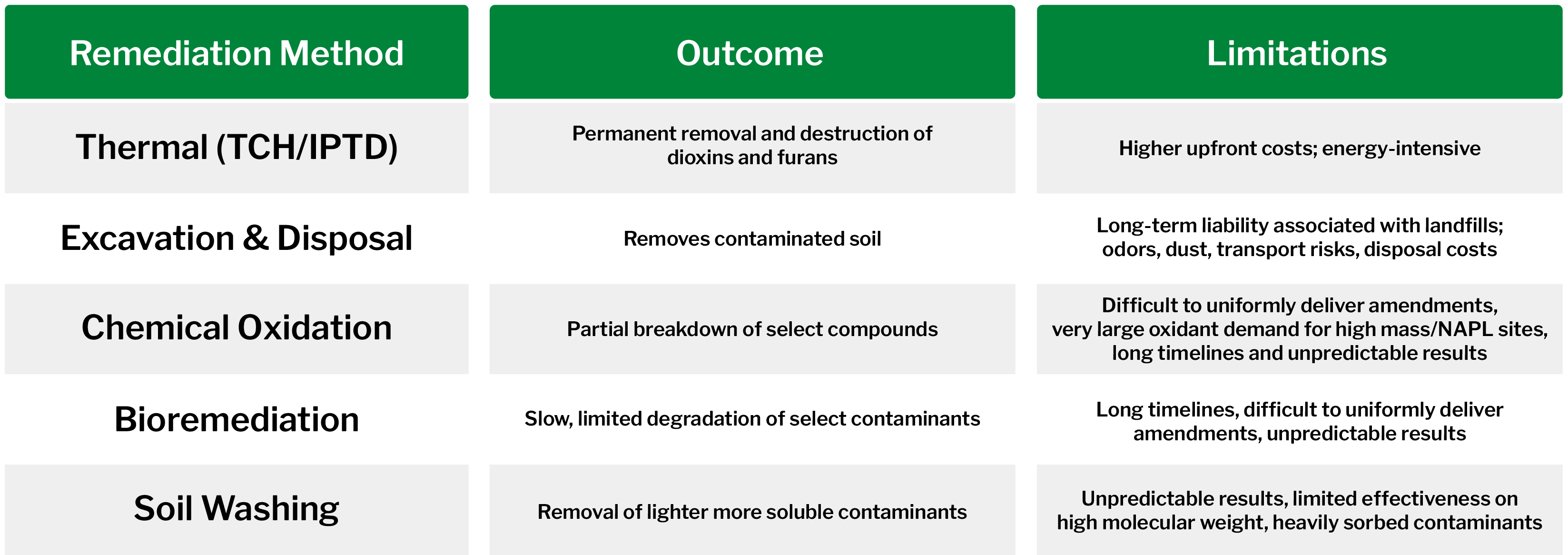
Traditional remediation methods, such as chemical oxidation, often struggle with dioxins and furans due to their chemical stability and strong affinity for soil, and excavation with landfill disposal, or stabilization present long-term liability risks. TerraTherm’s advanced thermal technologies offer an effective approach by applying controlled heat to mobilize and extract these contaminants from the subsurface. Under high temperature conditions, partial in situ degradation may occur, but the majority of contaminant destruction typically takes place during above-ground vapor treatment after the contaminants are desorbed, volatized, and removed from the subsurface.
Our Thermal Solutions
Thermal Conduction Heating (TCH)
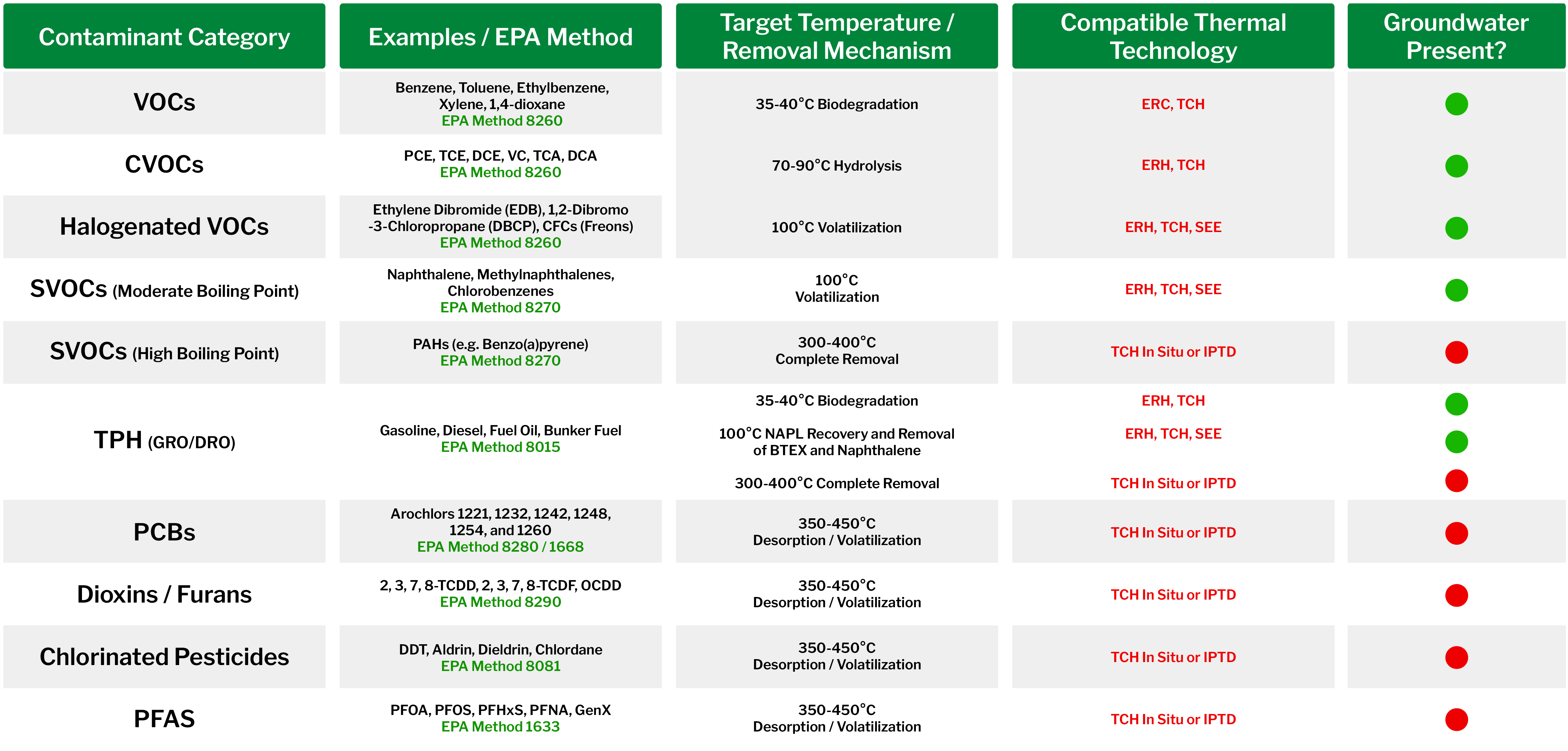
TCH is the only thermal technology that can heat soil and sediment to temperatures in the range required to effectively treat dioxins and furans (350 to 400°C). Heating soil and sediment to these temperatures facilitates the volatilization and in situ destruction of dioxins and furans. TCH relies on thermal conduction of energy from a heater into the surrounding soil or rock. TCH provides highly uniform and predictable heating because the thermal conductivity of most sites only varies by a factor of 2 to 3. Vapor extraction wells are required to maintain pneumatic control and recover volatized COCs during treatment
In-Pile Thermal Desorption (IPTD®)
IPTD uses TCH to provide ex-situ thermal remediation of soil and sediment that can treat any organic contaminant, including dioxins and furans, and streamline material handling and eliminates the need for off-site disposal of contaminated soils and sediment.
IPTD is highly flexible and easily customizable to optimize treatment of any soil volume, large or small. It involves placing contaminated soil and/or sediment within an engineered above-ground, fully covered and insulated treatment pile structure, and then heating the soil to the required temperature to destroy and/or remove the contaminants over periods of several weeks to several months. The design temperature and treatment period is dependent on the contaminants, and remedial goals. For treatment of soil contaminated with dioxins and furans, treatment temperatures between 350 and 400°C are typically required.
IPTD is a good fit for shallow soil contamination, excavated soil, or IDW when off-site disposal is not an option. On-site IPTD can be a cost-effective option for total treatment of contaminants like PFAS, PCBs, dioxins, furans, TPH, SVOCs and PAHs, which eliminates the long-term liability of disposal of the soil in a landfill. Importantly stringent soil standards can be achieved even for recalcitrant contaminants like dioxins and furans.
IPTD has been used to treat soil volumes as low as 50 cy and up to 70,000 cy. The size of the pile depends on the volume of material to be treated, space available, electrical power available and desired schedule.
Will Thermal Work for Your Site?
Tell us about your site and we'll tell you whether thermal treatment applies and which approach fits. If it isn't the right remedy, we'll say so.
How Does Thermal Compare to Other Methods?
Choosing the Right Solution
Our engineers assess site-specific conditions, including:
- Contaminant concentration and total mass
- Soil type, permeability, and organic content
- Depth of contamination and groundwater interaction
- Presence of co-contaminants
- Regulatory standards and cleanup objectives
For deep or tight soil contamination, TCH is highly effective. IPTD is the preferred option for sites where excavation and ex-situ treatment are feasible.
Regulatory Trends and Cleanup Goals
The USEPA and state regulatory agencies enforce strict cleanup standards for dioxins and furans, often at parts-per-trillion levels. Analytical quantification is commonly performed using high-resolution gas chromatography/high-resolution mass spectrometry (HRGC/MS) techniques via USEPA Method 1613B (isotope dilution method). Other methods exist for different matrices (waste, air). Cleanup targets are typically defined by site-specific risk assessments and regulatory thresholds. Thermal remediation technologies are increasingly recognized by regulators for their ability to achieve high removal efficiency and enable permanent site closure.
Ready to Address Dioxins or Furans at Your Site?
TerraTherm brings industry-leading expertise and proven thermal remediation solutions for even the most challenging dioxin and furan contamination scenarios. Our technologies deliver reliable, results-driven outcomes that support regulatory closure and site redevelopment.
TCH Technology Applicability