
PFAS Remediation
What Are PFAS and Why Are They a Problem?
Per- and polyfluoroalkyl substances (PFAS) are a large class of synthetic chemicals used in a variety of industrial and consumer products, including firefighting foams, non-stick coatings, textiles, and metal plating. Due to their strong carbon-fluorine bonds, PFAS are extremely resistant to degradation in the environment and are often referred to as "forever chemicals."
Once released into soil or groundwater, PFAS are highly mobile and do not naturally break down. Even at concentrations as low as parts per trillion, they pose significant health risks, including potential links to cancer, immune system suppression, thyroid disruption, and developmental effects. Their persistence and toxicity have led to increasingly stringent cleanup standards and regulatory enforcement at the federal and state levels and make typical stabilization, containment and excavation and landfilling remedies risky with follow-on long-term liability issues.
Common Sites with PFAS Contamination
- Military installations, airfields, and fire-training areas affected by AFFF use
- Airports and aviation-support facilities
- Chemical manufacturing and fluorochemical-processing facilities
- Metal plating and finishing operations
- Landfills and leachate-impacted areas
- Wastewater treatment plants and biosolids application areas
- Industrial facilities using fluorinated materials
- Sediment basins, ponds, and drainage systems receiving PFAS-impacted runoff
Thermal Remediation: A Proven Destructive Solution for PFAS-Impacted Soil and Sediment
Many PFAS remedies separate, stabilize, contain, or concentrate PFAS, leaving the compounds in place or transferring them to another residual stream. TerraTherm’s patent-pending integrated PFAS treatment process is designed to permanently destroy PFAS at the molecular level and sequester the resulting fluorine.
The patent-pending integrated process combines Thermal Conduction Heating (TCH) to heat the soil and sediment, engineered vapor extraction, removal of steam from the vapors, and polishing the vapor stream with a PFAS-focused thermal catalyst. Soil or sediment is heated to remove, degrade, and mineralize PFAS, generated vapors are captured under vacuum, and the catalyst promotes destruction of PFAS and fluorinated transformation products while binding fluorine as stable calcium fluoride.
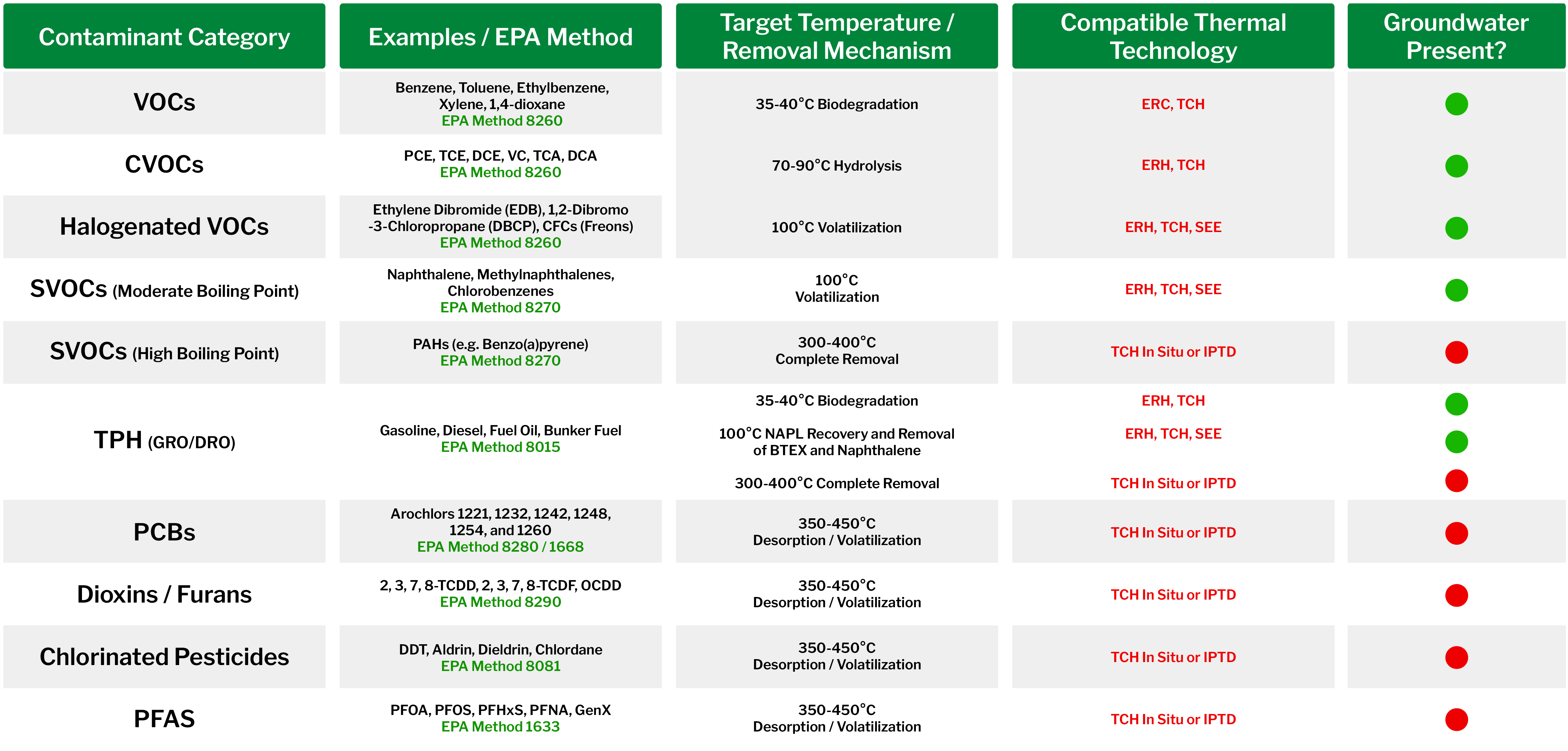
High-Temperature PFAS Removal and Destruction
|
Typical target temperature |
Primary mechanism |
Treatment temperature, residence time, energy input, and vapor handling are established from the PFAS profile, soil/sediment properties, organic carbon, moisture, cleanup goals, and emissions requirements.
Laboratory and pilot-scale demonstration data support TerraTherm’s conclusion that the integrated process can permanently destroy PFAS at the molecular level. Performance remains project-specific and is verified through treated-media sampling, vapor and condensate characterization, emissions testing, and fluorine mass-balance evaluation.
|
Fluorine Mass Balance TerraTherm’s laboratory mass-balance results found that approximately half of the fluorine remained in the treated soil or sediment following PFAS mineralization, while approximately half was mobilized in the vapor stream, and mineralized and retained by the thermal catalyst as calcium fluoride (CaF₂). This result supports the treatment concept: destroy PFAS and fluorinated vapor-phase byproducts, and sequester the resulting fluorine in stable mineral forms. |
|
Demonstrated PFAS Performance TerraTherm’s pilot demonstration results show greater than 99.9% PFAS destruction and removal from treated soil and sediment, with all target PFAS reported as non-detect at nanogram-level method reporting limits. OTM-45, OTM-50, and OTM-55 emissions testing reported no detectable PFAS, volatile fluorinated compounds, or greenhouse gases in the discharged vapor stream above applicable method and blank detection levels, together with very low hydrogen fluoride emissions. The reported mass balance indicated that approximately 98% of the starting PFAS mass was destroyed on site and approximately 2% was transferred to condensed liquids requiring secondary management. |
Our Heating Solutions for PFAS
Thermal Conduction Heating (TCH)
TCH transfers heat from subsurface heaters into surrounding soil by thermal conduction and can achieve the 350 to 400°C temperatures required for PFAS treatment. In situ TCH may be appropriate where soil can be heated safely and uniformly and groundwater or surface-water influx can be controlled. An insulated vapor cover and vapor extraction system limit heat loss, maintain pneumatic control, and capture generated vapors.
In-Pile Thermal Desorption (IPTD®)
IPTD applies TCH within a fully covered, insulated, engineered aboveground pile. Excavated soil or sediment is heated uniformly while vapors are captured under vacuum and routed to the thermal treatment system. IPTD is well suited to excavated soil, dredged sediment, investigation-derived waste, redevelopment projects, and sites where water control makes in situ high-temperature treatment impractical.
On-site IPTD can reduce or avoid transportation, stabilization, containment, and landfill disposal of PFAS-impacted material. Treated material management and reuse remain subject to project-specific characterization, cleanup criteria, and regulatory approval.
Thermal Catalyst Vapor Treatment System
Extracted steam and vapors are cooled and condensed before the noncondensable vapor stream enters the thermal catalyst system, a key component of TerraTherm’s patent-pending integrated PFAS treatment process. The calcium-based catalyst is designed to complete destruction of PFAS and fluorinated transformation products and sequester fluorine as calcium fluoride, limiting hydrogen fluoride formation and emissions.
The relatively small condensate stream is managed separately. Depending on project requirements, treatment options may include granular activated carbon (GAC), ion exchange, supercritical water oxidation (SCWO), hydrothermal alkaline treatment (HALT), or ultraviolet-activated silica-based granular media (UV/SGM).
Will Thermal Work for Your Site?
Tell us about your site and we'll tell you whether thermal treatment applies and which approach fits. If it isn't the right remedy, we'll say so.
How Does Thermal Compare to Other Methods?
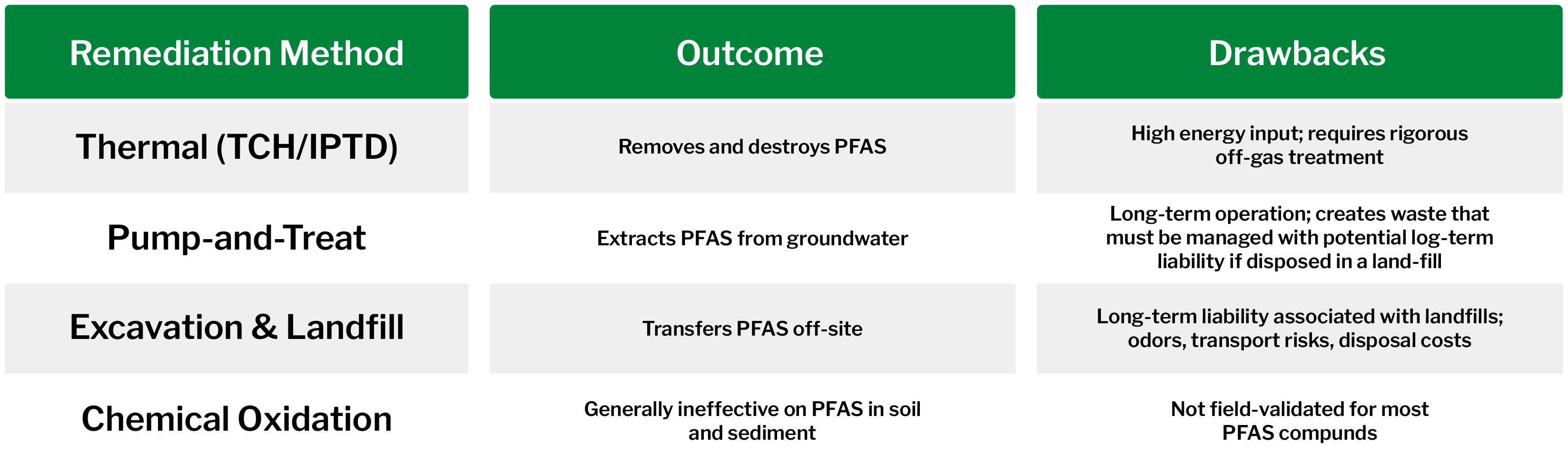
Choosing the Right Solution
TerraTherm tailors each PFAS remedy to site conditions and cleanup objectives. Our evaluation considers:
- PFAS composition, presence of precursors and other fluorinated compounds, concentration, and spatial distribution
- Soil or sediment type, organic carbon, moisture, and thermal properties
- Co-contaminants and their effect on vapor treatment
- Treatment depth, volume, geometry, and access constraints
- Groundwater and surface-water conditions and the ability to control recharge
- Cleanup goals, analytical methods, emissions requirements, and regulatory acceptance
- Material handling, redevelopment plans, schedule, power, and sustainability objectives
- Management of condensate and other residual streams
In situ TCH is selected where the treatment interval can be heated uniformly and water influx can be controlled. IPTD is selected where soil or sediment can be excavated and treated more effectively in an engineered pile. Both configurations use engineered vapor collection and the thermal catalyst treatment system as part of TerraTherm’s patent-pending integrated PFAS treatment process.
|
Why TerraTherm? TerraTherm combines decades of high-temperature thermal-remediation experience with a patent-pending integrated PFAS treatment process developed specifically to permanently destroy PFAS at the molecular level and manage fluorine. TerraTherm’s field-scale thermal desorption pilot at Peterson Space Force Base in Colorado Springs, Colorado, was evaluated under SERDP ESTCP Project ER23-8372, “Side-by-Side Evaluation of Field-Scale Treatment of PFAS-Impacted Sediments.” The program compared thermal desorption with smoldering and sediment washing, and evaluated concentrated liquid treatment using SCWO, HALT, and UV/SGM. It assessed PFAS removal and destruction, residual leachability, potential air emissions, field implementation considerations, and costs. TerraTherm’s laboratory and pilot results support permanent molecular destruction, low emissions, limited mass transfer to condensate, and fluorine sequestration as CaF₂, providing a treatment approach designed to address current and future regulated PFAS. View SERDP ESTCP Project ER23-8372 |
Ready to Address PFAS at Your Site?
TerraTherm is advancing PFAS remediation through a patent-pending integrated process that combines high-temperature treatment, engineered vapor management, and fluorine sequestration. We work with site owners, consultants, industrial operators, and regulators to evaluate in situ and IPTD options, define practical treatment boundaries, permanently destroy PFAS at the molecular level, minimize residual waste, and verify treatment performance.
TCH Technology Applicability