Contaminants
Thermal Solutions for Complex and Persistent Contamination
Every contaminant behaves differently below ground. Volatility, boiling point, chemical stability, soil adsorption, and the presence of NAPL all influence how contamination moves, how long it persists, and what is required to remove it.
That is why successful thermal remediation starts with the contaminant, not the technology.
TerraTherm evaluates the contaminants of concern, site geology, cleanup standards, contaminant distribution, and remedial goals before selecting a treatment approach. Our team can apply one thermal technology or combine multiple technologies to address complex source zones safely, efficiently, and reliably.
Targeted Treatment for Challenging Contaminants
Thermal remediation is particularly effective for contaminants that are difficult to remove using conventional methods. Heating can increase contaminant mobility, lower NAPL viscosity, accelerate degradation reactions, volatilize compounds for extraction, or destroy recalcitrant contaminants at elevated temperatures.
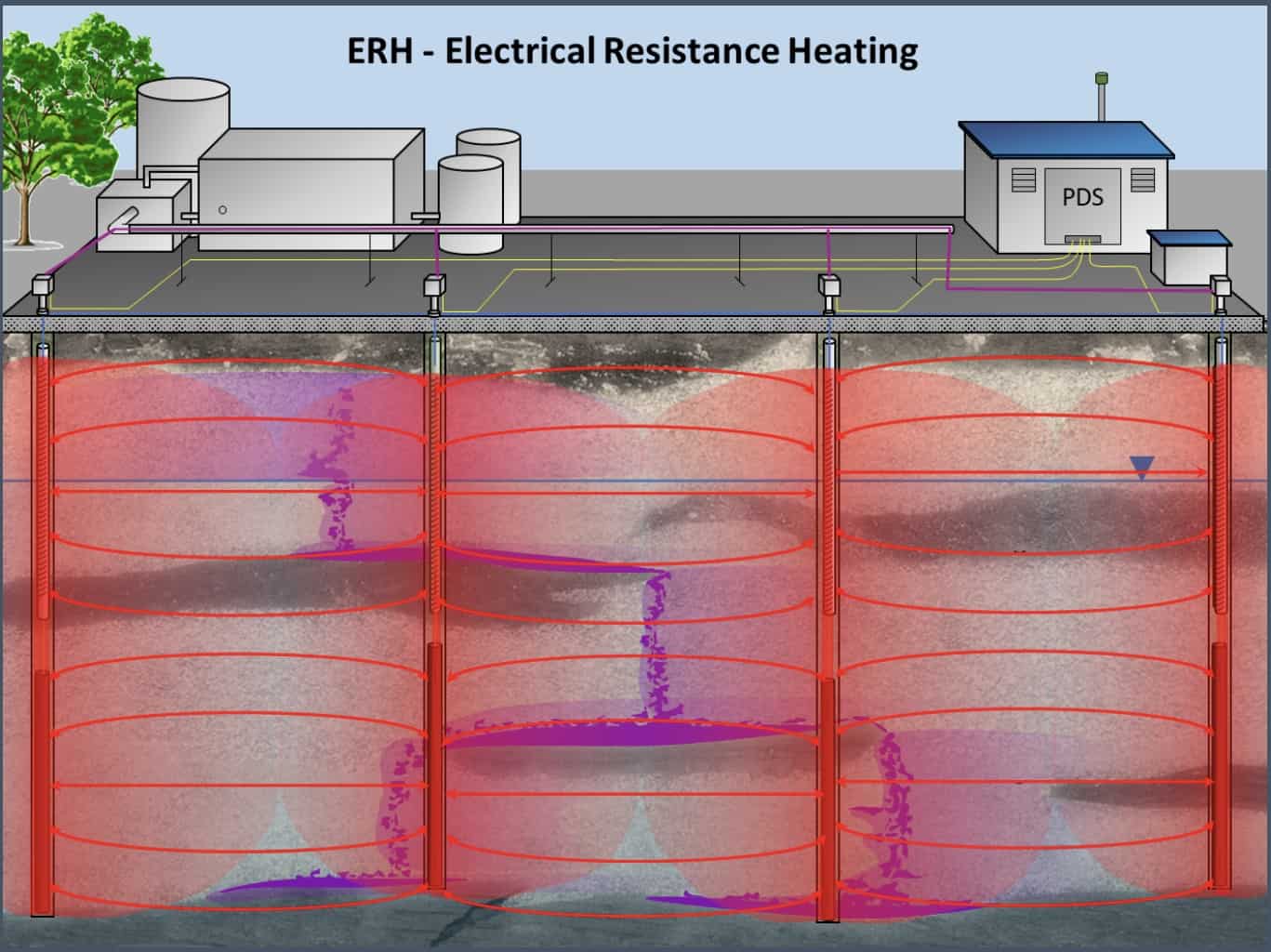
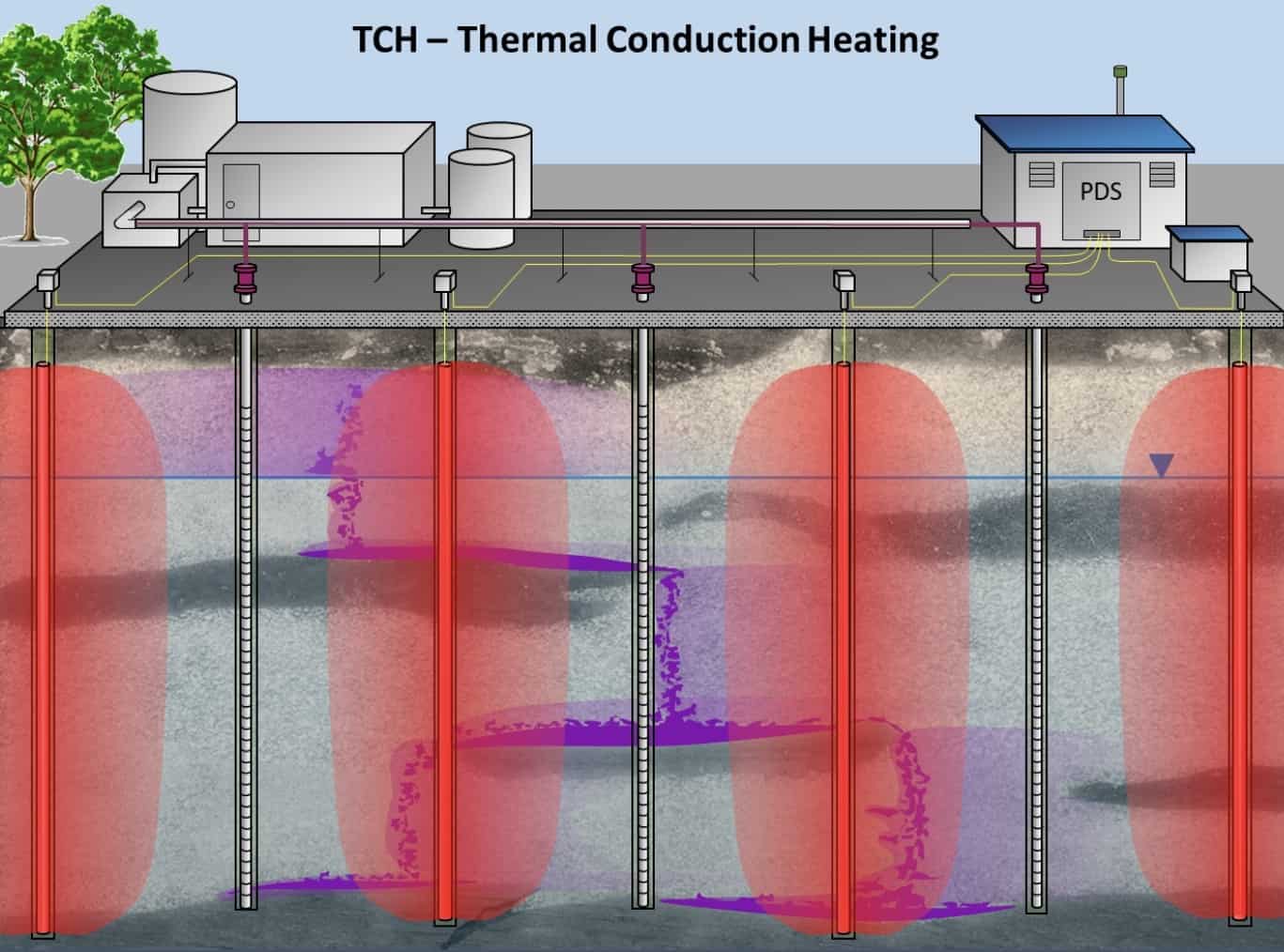
Depending on the contaminant and site conditions, TerraTherm may use:
- Electrical Resistance Heating (ERH)
- Thermal Conduction Heating (TCH)
- Steam Enhanced Extraction (SEE)
- In-Pile Thermal Desorption (IPTD®)
- Low-temperature heating for enhanced biodegradation or hydrolysis
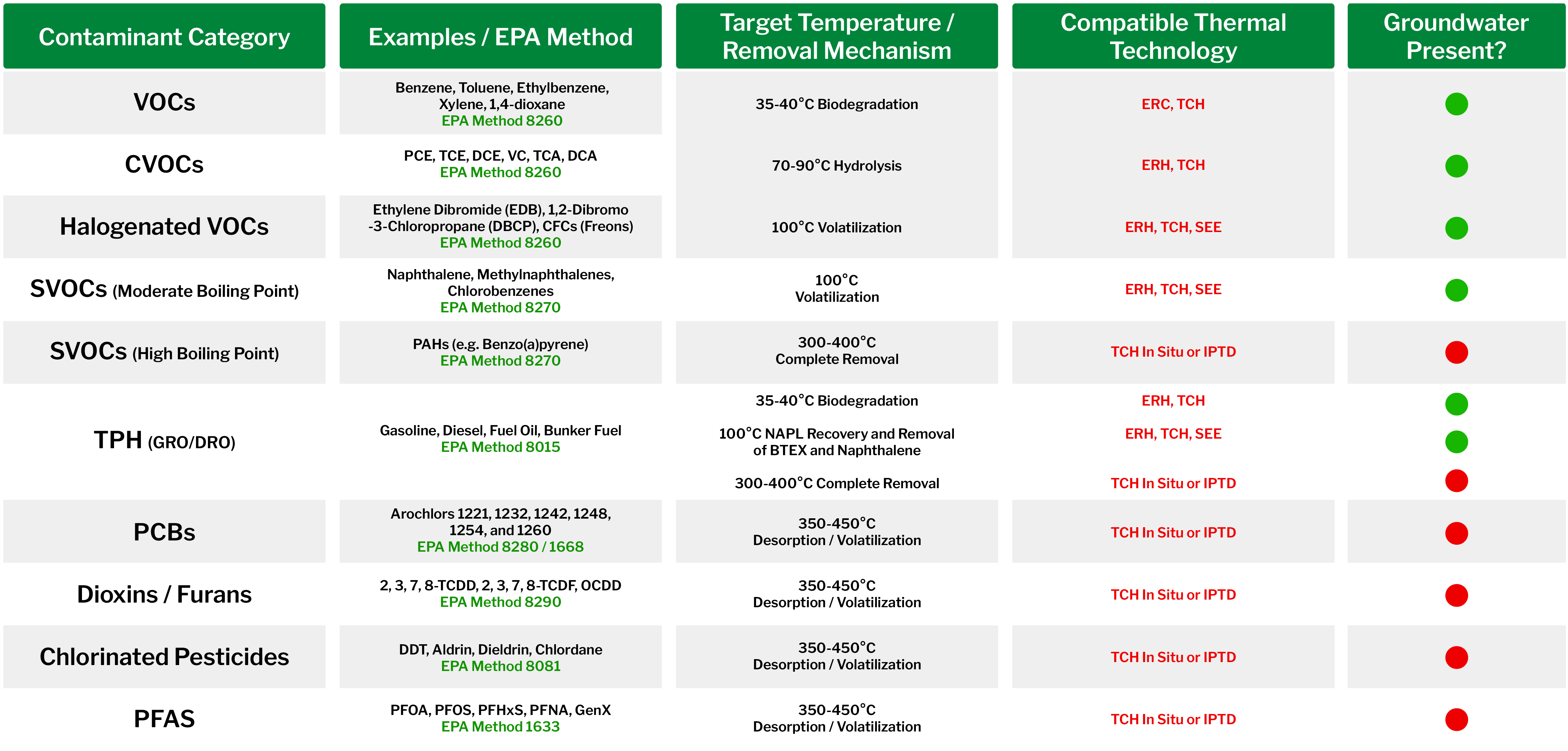
Treatment temperatures may range from approximately 35°C for enhanced biological degradation to 400°C for persistent, high-boiling-point contaminants. Each system is designed around the contaminant(s) targeted, the performance goals and the physical conditions of the site.
Contaminants We Treat
Volatile Organic Compounds
Volatile organic compounds, or VOCs, include petroleum-related compounds such as benzene, toluene, ethylbenzene, and xylenes, as well as many industrial solvents.
Because VOCs can migrate through soil, groundwater, and vapor pathways, they may create persistent source zones and long-term vapor intrusion risks. TerraTherm uses controlled heating to mobilize VOCs through co-boiling of NAPL and volatilization for capture, extraction, and above-ground treatment, or to enhance biotic or abiotic in situ degradation.
Chlorinated Volatile Organic Compounds
Chlorinated volatile organic compounds, or CVOCs, include PCE, TCE, TCA, DCA, vinyl chloride, carbon tetrachloride, and other chlorinated solvents historically used in degreasing and industrial operations.
These compounds were often released as dense non-aqueous phase liquids (DNAPLs) that migrated into low-permeability soils or fractured bedrock. Thermal remediation can directly target high-mass CVOC and DNAPL source zones that conventional pump-and-treat, soil vapor extraction, or injection-based systems may leave behind.
Creosote and Coal Tar
Creosote and coal tar are complex contaminant mixtures commonly associated with manufactured gas plants, wood-treatment facilities, coking operations, and other industrial sites.
These materials may contain BTEX, naphthalenes, polycyclic aromatic hydrocarbons (PAHs), and heavy petroleum hydrocarbons. TerraTherm can tailor treatment temperatures to reduce NAPL viscosity and recover mobile product, volatilize and remove volatile and semi-volatile compounds, or achieve substantial mass removal and stringent soil remedial goals for PAHs and TPH.
Explore Creosote and Coal Tar Remediation
SVOCs and PAHs
Semi-volatile organic compounds and polycyclic aromatic hydrocarbons are persistent contaminants frequently associated with coal tar, creosote, petroleum residues, industrial fill, and combustion byproducts.
Their high boiling points and strong affinity for soil organic matter can limit the effectiveness of biological, chemical, and physical treatment methods. TerraTherm uses high-temperature TCH in situ when subsurface conditions permit or its ex situ In-Pile Thermal Desorption (IPTD®) technology to desorb, extract, and destroy these difficult contaminants.
Explore SVOC and PAH Remediation
Polychlorinated Biphenyls
Polychlorinated biphenyls, or PCBs, were historically used in electrical equipment, hydraulic fluids, paints, and industrial applications. They are highly persistent, toxic, and strongly adsorbed to organic-rich soil and sediment.
PCB cleanup often requires treatment to stringent concentrations under TSCA or state regulatory programs. TerraTherm's high-temperature TCH systems, whether applied in situ or through IPTD®, can remove and destroy PCBs, achieving stringent soil cleanup goals while reducing the long-term liability associated with containment or landfill disposal.
Dioxins and Furans
Dioxins and furans are highly toxic compounds associated with combustion, waste incineration, chemical manufacturing, pesticide production, and legacy herbicide contamination.
These contaminants can pose risks at extremely low concentrations and are highly resistant to natural degradation. High-temperature thermal treatment, using in situ TCH or IPTD®, mobilizes dioxins and furans from soil and sediment so they can be captured and destroyed through controlled treatment systems.
Explore Dioxin and Furan Remediation
Chlorinated Pesticides
Chlorinated pesticides include DDT, aldrin, dieldrin, chlordane, heptachlor, endrin, and other persistent chemicals historically used in agricultural, residential, and industrial applications.
These compounds bind strongly to soil and sediment and may remain in the environment for decades. TerraTherm uses high-temperature TCH, whether applied in situ or through IPTD®, to overcome strong soil adsorption, remove contaminant mass, and support permanent site cleanup.
Explore Chlorinated Pesticide Remediation
PFAS
Per- and polyfluoroalkyl substances, or PFAS, are persistent synthetic compounds that can be difficult to address using conventional remediation methods because of their chemical stability and strong carbon-fluorine bonds.
For PFAS-impacted soil and sediment, TerraTherm can use high-temperature TCH in situ where site conditions permit or IPTD® for excavated material. These approaches heat contaminated material to the temperatures required for PFAS breakdown and mineralization while extracted vapors are captured and managed through controlled treatment systems.
Total Petroleum Hydrocarbons
Total petroleum hydrocarbons, or TPH, include a broad range of compounds derived from crude oil and refined petroleum products, including gasoline-, diesel-, and oil-range organics. Petroleum releases may also contain BTEX, naphthalene, PAHs, jet fuel, lubricating oils, and weathered petroleum residues.
Depending on the petroleum mixture and cleanup goals, TerraTherm can use low-temperature heating to accelerate biodegradation, boiling-point treatment to improve LNAPL recovery and remove volatile and lighter semi-volatile compounds, or high-temperature TCH and IPTD® to remove and destroy persistent PAHs and heavier petroleum hydrocarbons.
Halogenated VOCs, Refrigerants, and Fumigants
Halogenated volatile organic compounds include chemicals containing chlorine, bromine, fluorine, or other halogens. This group includes refrigerants, fumigants such as EDB, industrial solvents, aerosol propellants, and other specialty chemicals that may persist in soil and groundwater and create long-term groundwater or vapor-intrusion risks.
TerraTherm tailors treatment temperatures to the chemistry of the target compounds. Volatile contaminants and non-aqueous phase liquids can be mobilized and extracted near the boiling point of water, while susceptible compounds such as EDB may be destroyed through thermally enhanced hydrolysis at lower temperatures. Low-temperature heating may also enhance biological degradation where site conditions are suitable.
Explore Halogenated VOC, Refrigerant, and Fumigant Remediation
The Contaminant Is Only Part of the Equation
Selecting and designing a thermal remedy requires more than identifying the compounds present. TerraTherm also evaluates:
- Contaminant concentrations and total mass
- Presence of DNAPL or LNAPL
- Soil type, permeability, moisture content, and organic content
- Depth and configuration of the treatment zone
- Groundwater and surface water influx
- Bedrock conditions and fractures
- Co-contaminants requiring different treatment temperatures
- Regulatory standards and cleanup timelines
- Site access, redevelopment plans, and ongoing operations
A site may require low-temperature heating to accelerate hydrolysis, boiling-point treatment to remove VOCs, or temperatures above 300°C to treat persistent SVOCs, PCBs, pesticides, dioxins, furans, and PFAS.
TerraTherm has the technology portfolio and technical experience to select the right temperature, heating method, extraction system, and treatment duration for each project.
One Site May Require More Than One Technology
Sites with mixed geology or multiple contaminant classes may not be effectively treated with a single heating method.
TerraTherm can combine TCH, ERH, and SEE to address low-permeability soils, electrically conductive formations, permeable zones, groundwater flow, and fractured rock within the same treatment area. Excavated soil and sediment may also be treated using IPTD® when in situ high-temperature treatment is not practical.
This flexibility allows the remedy to be designed around the site instead of forcing the site into the limitations of one preferred technology.
Find the Right Thermal Solution for Your Site
Whether your site is affected by volatile solvents, CVOCs/DNAPL, coal tar, PAHs, PCBs, pesticides, dioxins, PFAS, or other persistent organic contaminants, TerraTherm can develop a thermal approach based on your specific conditions and cleanup objectives.
Our team works with site owners, consultants, contractors, and regulators to evaluate treatment options, manage technical risks, and achieve reliable remedial performance.