CVOC Remediation
Aggressive, Targeted Solutions for Complex Chlorinated Solvent Sites
Chlorinated volatile organic compounds (CVOCs) are synthetic chemicals commonly used as industrial solvents and degreasers. CVOCs include chlorinated ethenes (such as TCE, PCE, and vinyl chloride), ethanes (such as 1,1,1-trichloroethane or TCA, and 1,1-dichloroethane or DCA), and methanes (such as chloroform and carbon tetrachloride). These compounds are toxic and were often released to the subsurface as dense non-aqueous phase liquids (DNAPLs), which allowed them to migrate below the water table into low-permeability zones and fractured bedrock and persist for many decades.
CVOCs were commonly used as degreasing agents and are frequently found at legacy manufacturing, metalworking, aerospace, and dry-cleaning sites. Due to their physical/chemical properties, namely their low but toxic solubilities in water, density, and volatility, they can sink into the subsurface and remain trapped for decades, slowly dissolving into groundwater and posing long-term vapor intrusion and groundwater risks. Some breakdown
Common Sites with CVOC Contamination
- Aerospace manufacturing and degreasing operations
- Former electronics and metalworking plants
- Dry cleaning facilities
- Industrial landfills and sump discharge zones
- Chemical production and blending facilities
- Former solvent recycling facilities
Thermal Remediation: A Reliable Solution for CVOC Source Zones
High-Temperature Treatment for Source Zones (100 °C)
Removal Mechanism: Volatilization/Co-Boiling of the DNAPL and Phase Transfer
Unlike traditional pump-and-treat or SVE systems, thermal remediation methods can directly target DNAPL zones and overcome the mass-transfer limitations associated with the presence of DNAPL in low-permeability soils or fractured bedrock. TerraTherm’s advanced thermal technologies thoroughly heat the impacted zones to co-boil the DNAPLs and volatilize the CVOCs in situ for vapor-phase extraction and surface treatment. In some cases, partial in situ degradation occurs at elevated temperatures. This approach significantly reduces cleanup timeframes and long-term liability.
This approach can be used to clean up CVOC DNAPL source zones in 5 to 7 months and reliably achieve low remedial standards such as 0.1 mg/kg in soil or 0.05 mg/L in groundwater.
Note, lower concentration goals can be achieved (e.g., MCLs), however, thermal remediation is often used to surgically target CVOC source zones with the highest concentrations and most mass, and not the surrounding areas with low to moderate concentrations. Thus, it often isn’t possible or practicable to treat the source zone to very low concentrations, when mass flux into the source zone will prevent uniformly achieving the low concentration goals or result in future rebound.
Treatment goals, soil type, and organic carbon content, and specific CVOCs targeted, determine how much energy needs to be delivered to the target treatment zone and the duration of treatment. For example, if very low treatment goals are required for PCE (co-boiling point with water of 88.5 °C), for a site with high organic content, sufficient energy to boil off 35 to 40% of the water content of the treatment zone may need to be delivered. Higher treatment goals in low organic carbon soils for CVOCs with a lower boiling point, such as TCE (co-boiling point with water of 73 °C), may only require sufficient energy to boil off 25 to 30% of the water content.
Moderate-Temperature Treatment for In Situ Degradation (70 to 90 °C)
Removal Mechanism: Hydrolysis
For some CVOCs, such as 1,1,1-TCA, DCA, carbon tetrachloride (CT), and dichloromethane (DCM), their hydrolysis degradation rate will increase by several orders of magnitude when heated from ambient temperatures (e.g., 20 °C) to 70 to 90 °C. For these chemicals, even when present as DNAPL, heating to temperatures between 70 to 90°C, but below the boiling point of water, can be sufficient to reach low remedial goals at a site in 6 to 8 months.
Target treatment zones are typically heated to 70 to 90 °C in 90 days. Once at the target temperature, the power required to maintain the temperature is often 1/3 of what is required for initial heating. This approach also has the benefit of not requiring a vapor cover or extraction and treatment system, which greatly reduces costs and site access requirements. For example, the heater wells can be installed below grade, allowing normal access and operations in buildings and active work areas or transportation corridors. The combination of low-profile heaters, low power output, low target temperature, low maintenance power requirements, and no need for a vapor cover or extraction and treatment system makes this a very sustainable and low-cost approach.
Low-Temperature Treatment to Accelerate Bioremediation (35 to 40 °C)
Removal Mechanism: Biological Degradation
Increasing subsurface temperatures to 35 to 40 °C can increase the biological degradation rate of CVOCs by 2-3 times, resulting in shortening the overall remedial timeframe and reducing the off-site mass flux rate. This approach uses specially designed low-profile/low-power heaters that can be installed in a 2-inch diameter pipe and used to gently and uniformly heat the targeted treatment zone to the optimal temperature for biodegradation. The small-diameter heaters can be easily installed in direct-push borings, thus saving time and money if coordinated with amendment injections (e.g., EVO or EZVI).
Similar to when hydrolysis is the targeted removal mechanism, heating to 35 to 40C for biological degradation requires less power than heating to 100C, and does not require a vapor cover, extraction wells, or an extraction and treatment system. This approach also offers the same flexibility in terms of installation, making it a great approach for source zones located below buildings or in and around utilities. Because of the of low-profile heaters, low power output, low target temperature, and low maintenance power requirements, and no need for a vapor cover or extraction and treatment system, low-temperature thermally enhanced biodegradation is the most sustainable and lowest cost thermal remedy available.
Our Heating Solutions
Thermal Conduction Heating (TCH)
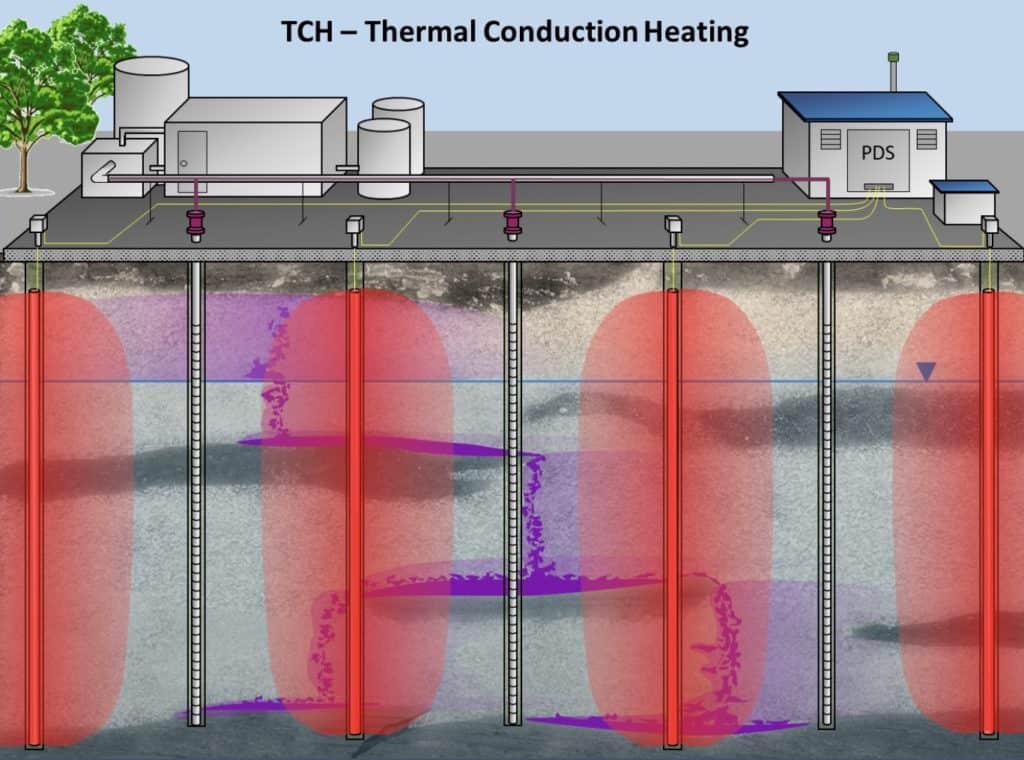
Effective in all soil types, regardless of moisture content (wet and dry, above and below the water table). Especially effective in fractured rock. It relies on thermal conduction of energy from a heater into the surrounding soil or rock. TCH provides highly uniform and predictable heating because the thermal conductivity of most sites only varies by a factor of 2 to 3.
TCH can be used to uniformly heat soil and rock to the full range of treatment temperatures required for the various CVOC treatment approaches: 35 to 40 °C for thermally enhanced biodegradation, 70 to 90 °C for thermally enhanced hydrolysis, and 100 °C for volatilization and co-boiling of DNAPL. Importantly, at some sites with low-permeable soils (e.g., silts and clays), the soil immediately surrounding the heaters (e.g., 6 inches) will dry out, which can provide essential pathways for volatilized CVOCs to migrate from deeper soils to the vadose zone where they can be effectively captured and removed for treatment.
For 100 °C treatment approaches, soil vapor extraction wells, either co-located with the electrodes or separate vertical or horizontal wells, are required to maintain pneumatic control during treatment. At some sites with sufficiently high groundwater flux rates, multiphase extraction wells may be used to remove vapor and water (and NAPL) to provide both pneumatic and hydraulic control during heating.
Electrical Resistance Heating (ERH)
Ideal for moist, heterogeneous soils (e.g., silty, clayey sands and clays). ERH can be used to heat subsurface areas to approximately 100°C, boiling DNAPL and volatilizing CVOCs like PCE, TCE, TCA, and DCA for vapor-phase extraction. As ERH relies on the current flow between electrodes placed in and around the target treatment zone to heat the soil and groundwater, it requires sufficient soil moisture and electrical conductivity; performance may be reduced in dry formations unless it can be practically and effectively mitigated through water addition at the electrodes, and in some resistive formations (e.g., fractured granite and dry sand), it is not effective.
For 100 °C treatment approaches, soil vapor extraction wells, either co-located with the electrodes or separate vertical or horizontal wells, are required to maintain pneumatic control during treatment. At some sites with sufficiently high groundwater flux rates, multiphase extraction wells may be used to remove vapor and water to provide both pneumatic and hydraulic control during heating.
ERH can also be used to gently and uniformly heat sites to 35 to 40 °C for thermally enhanced biodegradation or 70 to 90 °C for thermally enhanced hydrolysis.
Steam Enhanced Extraction (SEE)
Injects steam into the subsurface to co-boil DNAPL and strip CVOCs from saturated soils or fractured rock with sufficient permeability. Generally, SEE requires effective hydraulic conductivities of 1 x 10⁻³ cm/s or higher (e.g., sand and/or gravel formations). When properly designed, SEE can inject high rates of energy and quickly and uniformly heat and treat CVOC sites. If site conditions are amenable and subsurface permeabilities high enough, SEE is often the most cost-effective way of heating and treating CVOC DNAPL source zones due to the wide spacings that can be used between the steam injection wells, the high energy input rates, and typically low cost of the fuel for producing the steam.
Because steam is injected into the subsurface under pressure at temperatures > 100 °C, it is not a good candidate for gently heating sites to temperatures < 100 °C for thermally enhanced biodegradation or hydrolysis.
In addition, because the steam is injected under pressure and can condense as water, an aggressive network of multiphase extraction wells is required to extract both vapors and liquids (water and NAPL) to maintain pneumatic and hydraulic control during treatment.
SEE can be combined with ERH or TCH to treat sites with both low and high permeability zones that have low and high groundwater flux.
How Does Thermal Compare to Other Methods?
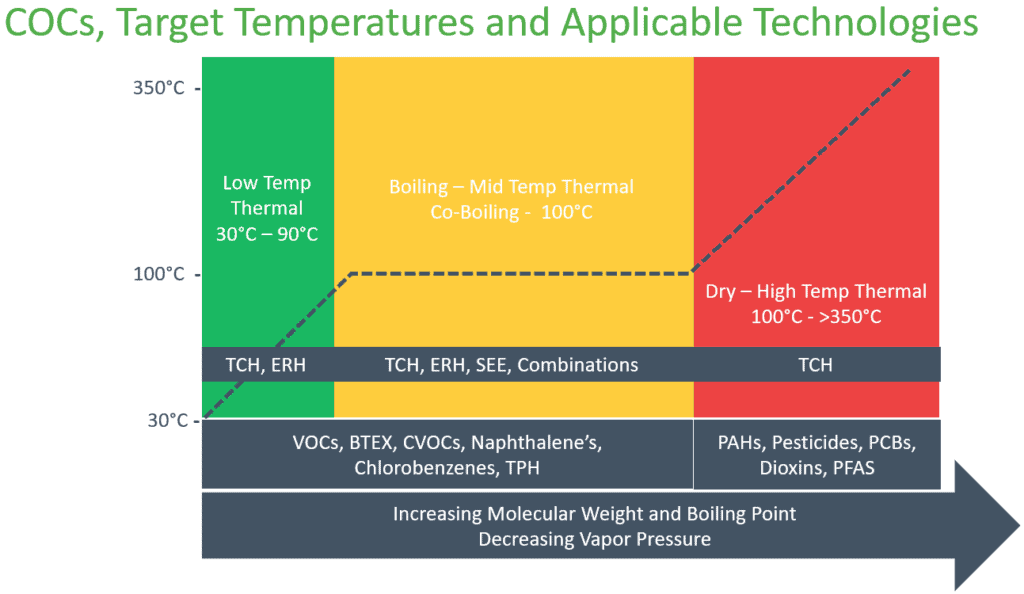
Contaminant Treatment Matrix
Target temperature, removal mechanism, and compatible thermal technologies by contaminant group.
| Contaminant Category | Examples | Target Temperature / Removal Mechanism | Compatible Thermal Technology | Groundwater Present? |
|---|---|---|---|---|
| Benzene, Toluene, Ethylbenzene, Xylene, 1,4-dioxane | 35 to 40°CBiodegradation | Yes | ||
CVOCs |
PCE, TCE, DCE, VC, TCA, DCA | 70 to 90°CHydrolysis | Yes | |
Halogenated VOCs |
Ethylene Dibromide (EDB), 1,2-Dibromo-3-Chloropropane (DBCP), CFCs (Freons) | 100°CVolatilization | Yes | |
| Naphthalene, Methylnaphthalenes, Chlorobenzenes | 100°CVolatilization | Yes | ||
| PAHs (e.g., Benzo(a)pyrene) | 300 to 400°CComplete Removal |
TCH
In Situ or IPTD
|
No | |
TPH (GRO/DRO) |
Gasoline, Diesel, Fuel Oil, Bunker Fuel | 35 to 40°CBiodegradation | Yes | |
| 100°CNAPL Recovery and Removal of BTEX and Naphthalene | Yes | |||
| 300 to 400°CComplete Removal |
TCH
In Situ or IPTD
|
No | ||
PCBs |
Arochlors 1221, 1232, 1242, 1248, 1254, and 1260 | 350 to 450°CDesorption / Volatilization |
TCH
In Situ or IPTD
|
No |
Dioxins / Furans |
2,3,7,8-TCDD, 2,3,7,8-TCDF, OCDD | 351 to 450°CDesorption / Volatilization |
TCH
In Situ or IPTD
|
No |
Chlorinated Pesticides |
DDT, Aldrin, Dieldrin, Chlordane | 352 to 450°CDesorption / Volatilization |
TCH
In Situ or IPTD
|
No |
| PFOA, PFOS, PFHxS, PFNA, GenX | 353 to 450°CDesorption / Volatilization |
TCH
In Situ or IPTD
|
No |
Choosing the Right Solution
TerraTherm engineers customize every remediation approach based on site-specific characteristics and our client’s remediation objectives. We assess:
- Soil type and permeability
- Contaminant depth and distribution
- Contaminant type and presence of DNAPL and co-contaminants
- Starting contaminant mass
- Site access limitations and surrounding land use
- Regulatory targets and timeline constraints
For sites with CVOCs like PCE, TCE, TCA, or DCA, TCH or ERH are both very good options for most geologies. Selecting one or the other depends on site-specific conditions such as soil electrical resistivity, soil moisture, depth of treatment, and the need to treat bedrock. SEE is a very good option for permeable sites with high groundwater flux, and we will often combine SEE with TCH or ERH to effectively heat and treat sites that have both low and high permeability zones.
Ready to Address CVOCs at Your Site?
Our team has successfully remediated some of the most complex chlorinated solvent sites in the U.S. Using field-proven thermal technologies and data-driven design, we help site owners and consultants achieve regulatory closure faster.
Talk to a Thermal Remediation Expert
Explore Our CVOC Remediation Technologies:
●Electrical Resistance Heating (ERH)
●Steam Enhanced Extraction (SEE)
●Thermal Conduction Heating (TCH)
Contact our Thermal Experts Today to Learn More About Thermal Conduction Heating

John LaChance
John LaChance is the Vice President of Development at TerraTherm. In his 30+ year career in the remediation industry, he has worked on a range of project sites, including chemical manufacturing plants, gas stations, oil refineries, railroads, former MGP sites,...

Steffen Griepke
Steffen Griepke is the Vice President of Technology at TerraTherm. In this role, he helps clients determine if a thermal remedy would work on their project site and, if so, which thermal technology or combination of technologies would be the most cost-effectiv...