PFAS Remediation
What Are PFAS and Why Are They a Problem?
Per- and polyfluoroalkyl substances (PFAS) are a large class of synthetic chemicals used in a variety of industrial and consumer products, including firefighting foams, non-stick coatings, textiles, and metal plating. Due to their strong carbon-fluorine bonds, PFAS are extremely resistant to degradation in the environment and are often referred to as "forever chemicals."
Once released into soil or groundwater, PFAS are highly mobile and do not naturally break down. Even at concentrations as low as parts per trillion, they pose significant health risks, including potential links to cancer, immune system suppression, thyroid disruption, and developmental effects. Their persistence and toxicity have led to increasingly stringent cleanup standards and regulatory enforcement at the federal and state levels.
Common Sites with PFAS Contamination
- Military bases and airfields due to aqueous film-forming foam (AFFF) use
- Firefighting training facilities
- Chemical manufacturing and electroplating operations
- Landfills and areas impacted by leachate or industrial waste
- Wastewater treatment plants and biosolids application zones
Thermal Remediation: A Promising Solution
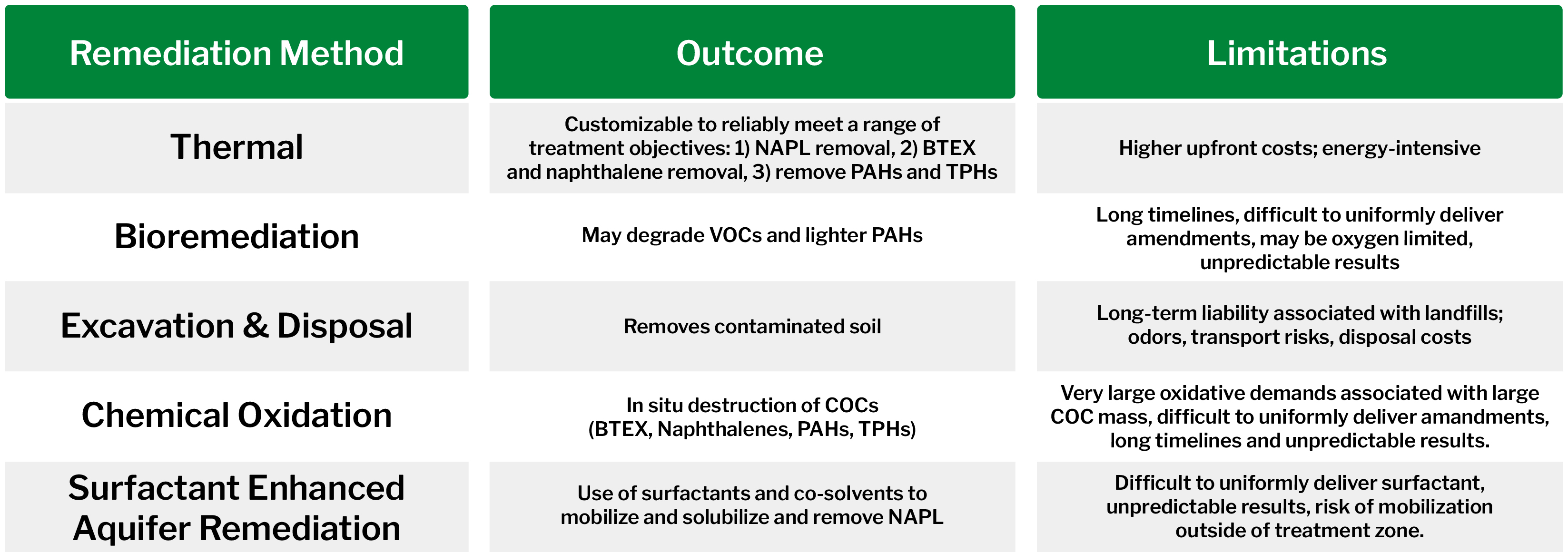
Many technologies merely transfer PFAS from one medium or location to another, creating long-term liability without true destruction. TerraTherm’s patent-pending high temperature thermal remediation technology offers a fundamentally different solution that permanently destroy PFAS in soil and sediment at the molecular level, while safely managing fluorinated byproducts onsite.
Using TerraTherm’s proven Thermal Conduction Heating (TCH) technology, combined with our innovative thermal catalysts for treating vapors, soils and sediments are heated to temperatures required for PFAS breakdown, mineralization, and secure fluorine sequestration, delivering predictable performance even under the most stringent remedial and emissions requirements.
Our laboratory and field demonstration results have shown:
- >99.9% PFAS destruction and removal from soil and sediment, with post-treatment samples non-detect at ng-level detection limits for all target PFAS
- No detectable PFAS, VFCs, or greenhouse gases in the discharged vapor stream above method and blank detection levels based on OTM-45, OTM-50, and OTM-55 emissions testing
- Very low hydrogen fluoride emissions
- ~98% of total PFAS mass destroyed onsite
- Only ~2% of starting PFAS mass transferred to condensed liquids requiring secondary treatment or disposal
Fluorine Mass Balance Closure
Laboratory fluorine mass balance results confirmed the fundamental destruction mechanisms:
- ~50% of fluorine retained in treated soil/sediment as a result of PFAS degradation and mineralization
- ~50% of fluorine bound to the thermal catalyst as CaF₂, demonstrating effective fluorine sequestration
Our Solutions
Thermal Conduction Heating (TCH)
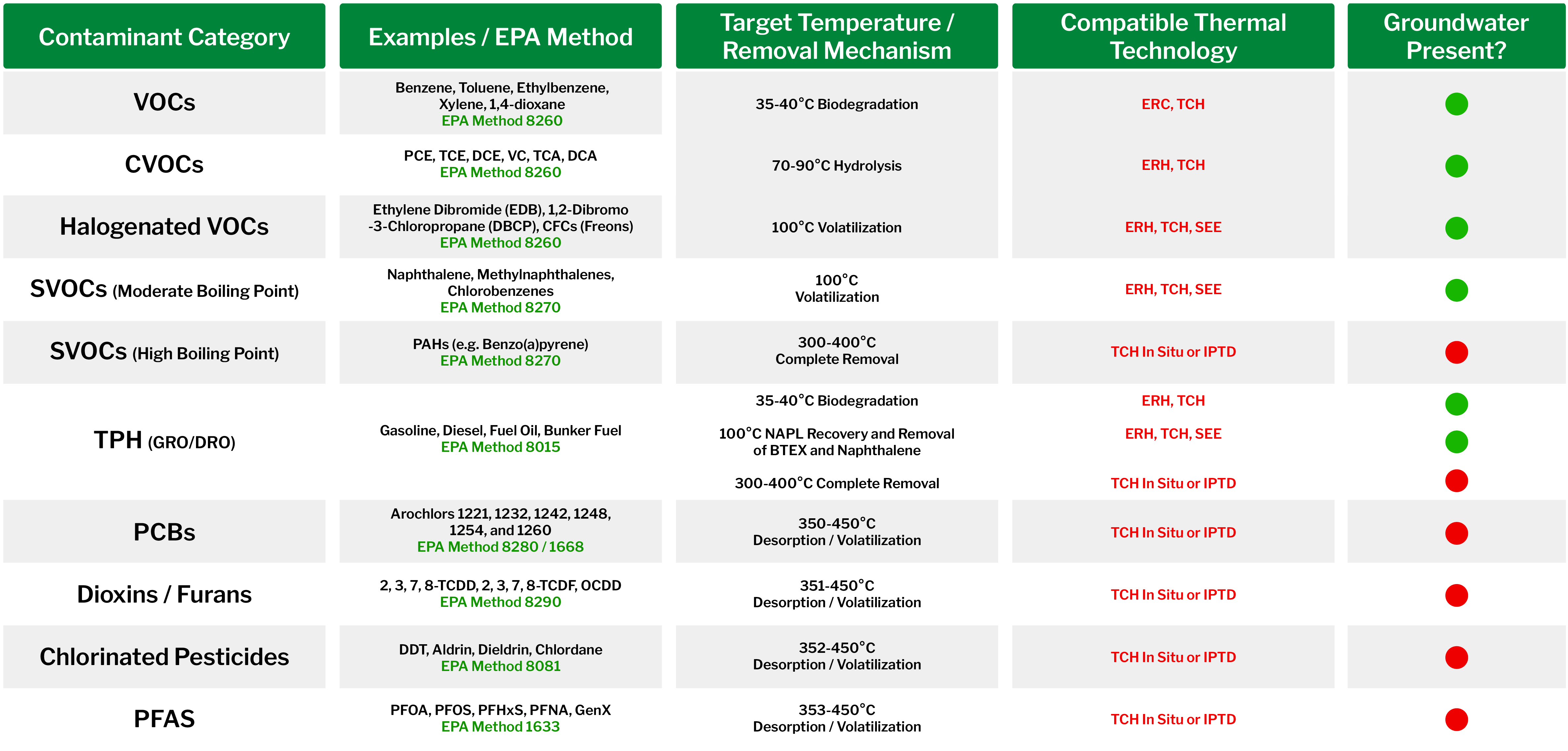
TCH is the only thermal technology that can heat soil and sediment to temperatures in the range required to effectively treat PCBs (350 to 400°C). Heating soil and sediment to these temperatures facilitates the volatilization and in situ destruction of PCBs. TCH relies on thermal conduction of energy from a heater into the surrounding soil or rock. TCH provides highly uniform and predictable heating because the thermal conductivity of most sites only varies by a factor of 2 to 3. Vapor extraction wells are required to maintain pneumatic control and recover volatilized COCs during treatment
In-Pile Thermal Desorption (IPTD®)
IPTD uses TCH to provide ex-situ thermal remediation of soil and sediment, treating any organic contaminant, including PFAS, and streamlining material handling while eliminating the need for off-site disposal of contaminated soils and sediment.
IPTD is highly flexible and easily customizable to optimize treatment of any soil volume, large or small. It involves placing contaminated soil and/or sediment within an engineered above-ground, fully covered and insulated treatment pile structure, and then heating the soil to the required temperature to destroy and/or remove the contaminants over periods of several weeks to several months. The design temperature and treatment period depend on the contaminants and remedial goals. For treatment of soil and sediments contaminated with PFASs, treatment temperatures between 350 and 400°C are typically required.
IPTD is a good fit for shallow soil contamination, excavated soil, or IDW when off-site disposal is not an option. On-site IPTD can be a cost-effective option for the total treatment of contaminants such as PFAS, eliminating the long-term liability of landfill disposal of the soil. Importantly, stringent soil standards can be achieved even for recalcitrant contaminants like dioxins and furans.
IPTD has been used to treat soil volumes as low as 50 cy and up to 70,000 cy. The size of the pile depends on the volume of material to be treated, space available, electrical power available, and desired schedule.
Thermal Catalyst Vapor Treatment System for Extracted Vapors
Vapors and steam generated during heating soil and sediment in situ or IPTD are actively extracted and treated in a thermal catalytic oxidation system using a catalyst incorporating calcium hydroxide [Ca(OH)₂], which plays a critical dual role:
- Completing the mineralization of PFAS, PIDs, and VFCs, and
- Sequestering fluorine as stable calcium fluoride (CaF₂), thereby limiting hydrogen fluoride (HF) formation and emissions.
Extracted vapors are subsequently cooled and condensed to remove water. The small volume of condensate, typically containing approximately 2% of the original PFAS mass, is managed separately using granular activated carbon (GAC), ion exchange resins, or destructive technologies such as SCWO, HALT, or UV/SGM, depending on project needs.
How Does Thermal Compare to Other Methods?
Choosing the Right Solution
Each PFAS-impacted site requires a detailed assessment of site conditions and remediation goals. TerraTherm engineers evaluate:
- Nature and concentration of PFAS present
- Presence of co-contaminants (e.g., CVOCs)
- Soil permeability, saturation, and organic content
- Depth and extent of contamination
- Volume of impacted material
- Presence of groundwater and potential for surface water infiltration
- Regulatory requirements and risk-based cleanup goals
TCH may be used in situ for unsaturated zones with minimal excavation access. IPTD is well suited for excavatable soil and allows for a high degree of control and performance verification. Both options are supported by robust vapor treatment such as our patent-pending thermal catalyst system to ensure safe and compliant emissions management.
Key Differentiators
- Permanent, destructive treatment, not transfer or containment
- Proven performance for current and future regulated PFAS
- Full-scale experience at temperatures required for PFAS destruction
- Integrated vapor treatment and fluorine sequestration strategy
- Defensible emissions performance supported by field data
- Scalable solutions for both in situ and ex situ applications
Regulatory Trends and Cleanup Goals
Federal and state agencies continue to lower the acceptable thresholds for PFAS in soil and groundwater. The EPA’s proposed maximum contaminant levels for PFOA, PFOS, and other PFAS compounds are among the strictest in environmental regulation. Thermal remediation technologies are gaining recognition as viable tools for addressing soil-based PFAS contamination, especially where long-term management or liability reduction is a priority.
Ready to Address PFAS at Your Site?
TerraTherm is advancing the field of PFAS remediation with innovative thermal technologies, real-world testing, and expert system engineering. Our solutions help site owners meet the most demanding regulatory expectations with future-focused, performance-driven systems.
Talk to a Thermal Remediation Expert
Explore Our PFAS Remediation Technologies:
TCH Technology Applicability